
Exposition à la chapelle de la pyramide du Mont-Cenis
De la Pentecôte à la Toussaint 2026
POUVOIRS
Poteri
Forces
Macht
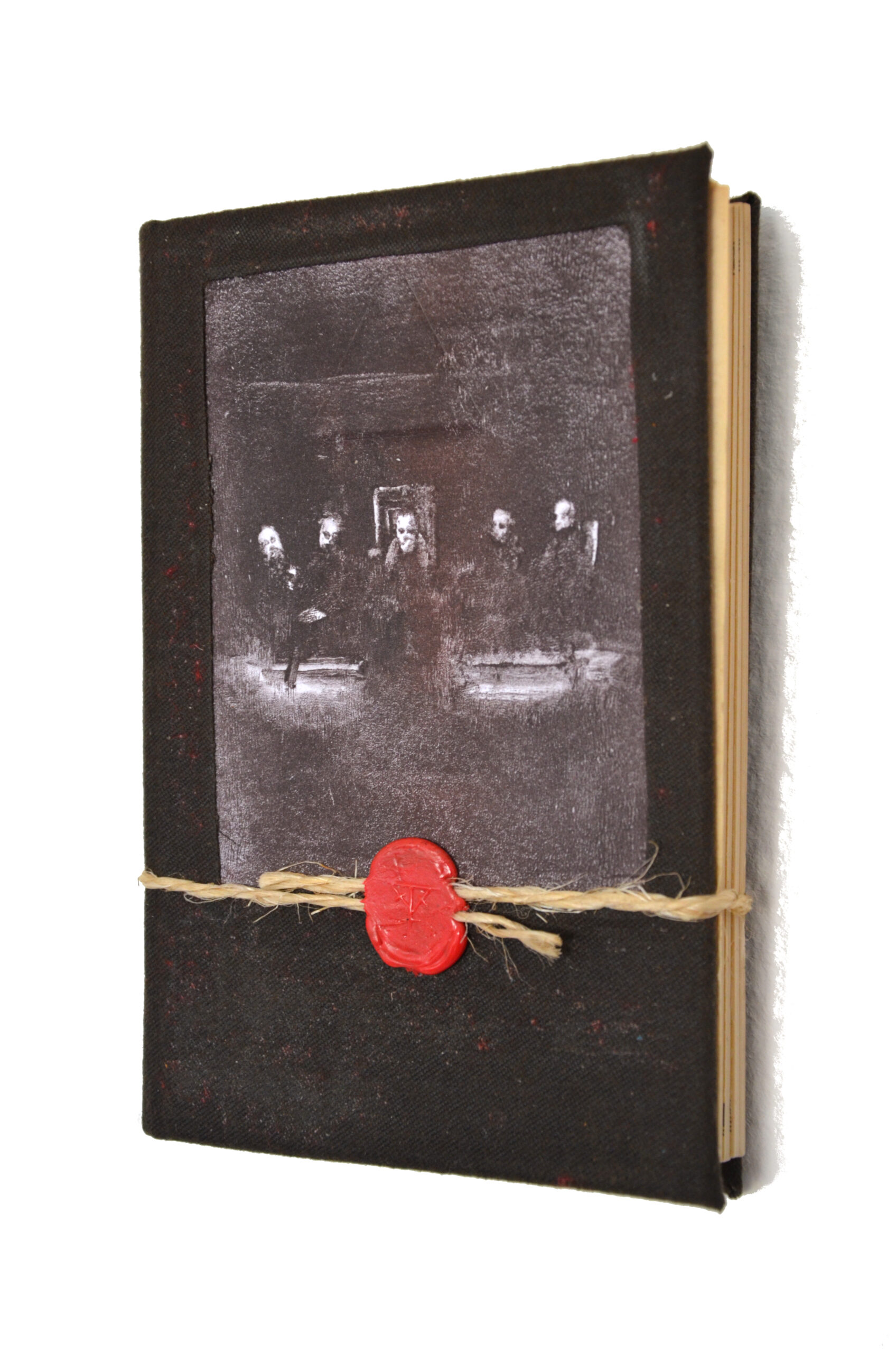
Monotipo goffrato su libro sigillato / Embossed monotype on a sealed book / Geprägter Monotyp auf versiegeltem Buch
La locution latine In camera recoupe la locution française « à huis clos ». Ce volume est opaque, sombre et sans titre apparent. Dans l’image centrale, cinq visages se distinguent. Cinq personnages sont attablés et les formes pâles de leurs visages sont alignés. Néanmoins, une première forme de hiérarchie se dégage avec l’imposant dossier de la chaise de la figure centrale, elle-même ceinte de ce qui ressemble à une écharpe claire qui le distingue des autres.
Mais le terme « hiérarchie » nous est principalement inspiré par la forme pyramidale embossée dans la couverture, en sa partie haute et centrale. En prolongeant les côtés latéraux de ce triangle équilatéral, on obtiendrait la base d’un plus grand triangle avec l’alignement des cinq figures. Ces cinq juges menaçants que le regardeur semble interrompre dans une réunion « à huis clos », ces cinq figures ne sont donc qu’un stade hiérarchique intermédiaire, dans un empilement vertigineux à la Kafka.
Tout dans ce volume reflète le secret du titre. La pyramide n’est pas franche mais se devine en relief, de derrière la couverture ; dans l’image, l’espace est plongé dans la pénombre ; le sceau garde le secret du contenu du volume comme tous les travaux de cette série, et il est accompagné ici d’un signet du même rouge de l’urgence qui accroît le mystère en nous enjoignant à poursuivre la lecture d’un volume hermétique.
L’espressione latina «In camera» corrisponde all’espressione «a porte chiuse». Questo volume è opaco, cupo e privo di titolo apparente. Nell’immagine centrale si distinguono cinque volti. Cinque personaggi sono seduti a tavola e i contorni pallidi dei loro volti sono allineati. Tuttavia, emerge una prima forma di gerarchia grazie all’imponente schienale della sedia della figura centrale, a sua volta avvolta da quella che sembra una sciarpa chiara che la distingue dagli altri.
Ma il termine «gerarchia» ci viene suggerito principalmente dalla forma piramidale impressa nella copertina, nella sua parte superiore e centrale. Prolungando i lati laterali di questo triangolo equilatero, si otterrebbe la base di un triangolo più grande con l’allineamento delle cinque figure. Questi cinque giudici minacciosi che lo spettatore sembra interrompere in una riunione «a porte chiuse», queste cinque figure non sono quindi che uno stadio gerarchico intermedio, in un vertiginoso accumulo alla Kafka.
Tutto in questo volume riflette il segreto del titolo. La piramide non è evidente ma si intuisce in rilievo, da dietro la copertina; nell’immagine, lo spazio è immerso nella penombra; il sigillo custodisce il segreto del contenuto del volume come tutte le opere di questa serie, ed è qui accompagnato da un segnalibro dello stesso rosso dell’urgenza che accresce il mistero esortandoci a proseguire la lettura di un volume ermetico.
The Latin phrase In camera corresponds to the phrase ‘behind closed doors. This volume is opaque, dark and has no apparent title. In the central image, five faces can be made out. Five figures are seated at a table, their pale faces aligned. Nevertheless, a rudimentary hierarchy emerges from the imposing backrest of the central figure’s chair, which is itself encircled by what resembles a light-coloured sash that distinguishes him from the others.
But the term ‘hierarchy’ is primarily suggested to us by the pyramidal shape embossed on the cover, in its upper central section. By extending the sides of this equilateral triangle, one would obtain the base of a larger triangle aligned with the five figures. These five menacing judges, whom the viewer seems to have interrupted in a ‘closed-door’ meeting, are thus merely an intermediate hierarchical stage in a dizzying Kafkaesque stack.
Everything in this volume reflects the secret of the title. The pyramid is not clearly visible but can be glimpsed in relief from behind the cover; in the image, the space is plunged into semi-darkness; the seal guards the secret of the volume’s contents, as in all the works in this series, and here it is accompanied by a bookmark in the same urgent red that heightens the mystery by urging us to continue reading this hermetic volume.
Der lateinische Ausdruck „In camera“ entspricht dem Ausdruck „unter Ausschluss der Öffentlichkeit“. Dieser Band ist undurchsichtig, dunkel und ohne erkennbaren Titel. Im zentralen Bild sind fünf Gesichter zu erkennen. Fünf Personen sitzen am Tisch, und die blassen Umrisse ihrer Gesichter sind in einer Reihe angeordnet. Dennoch zeichnet sich eine erste Form von Hierarchie ab, durch die imposante Rückenlehne des Stuhls der zentralen Figur, die selbst von etwas umgürtet ist, das wie eine helle Schärpe aussieht und sie von den anderen unterscheidet. Der Begriff „Hierarchie“ wird uns jedoch vor allem durch die pyramidenförmige Prägung im oberen, zentralen Teil des Einbands suggeriert. Verlängert man die Seiten dieses gleichseitigen Dreiecks, erhält man die Basis eines größeren Dreiecks, in dem die fünf Figuren auf einer Linie stehen. Diese fünf bedrohlichen Richter, die der Betrachter in einer „geschlossenen“ Sitzung zu stören scheint, sind also nur eine hierarchische Zwischenstufe in einer schwindelerregenden Anordnung à la Kafka. Alles in diesem Band spiegelt das Geheimnis des Titels wider. Die Pyramide ist nicht deutlich zu erkennen, lässt sich aber hinter dem Einband erahnen; im Bild ist der Raum in Halbdunkel getaucht; das Siegel bewahrt das Geheimnis des Inhalts des Bandes wie alle Werke dieser Reihe, und es wird hier von einem Lesezeichen in demselben Rot der Dringlichkeit begleitet, das das Geheimnis noch verstärkt, indem es uns dazu auffordert, die Lektüre eines hermetischen Bandes fortzusetzen.
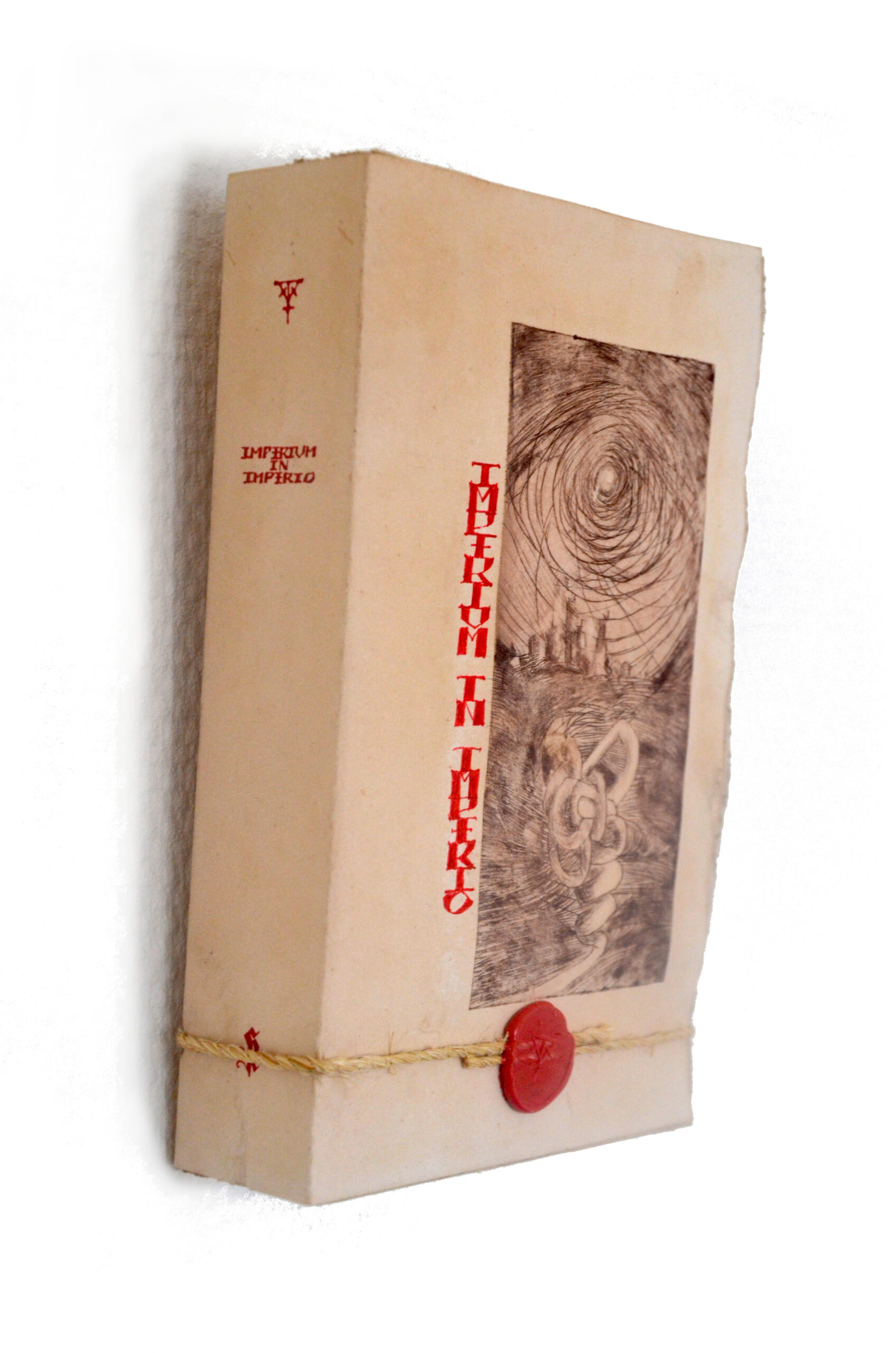
Incisione su plexiglas, monotipo su libro sigillato / Monotype etching on Plexiglas mounted on a bound book / Einzelabzug einer Plexiglas-Radierung auf einem versiegelten Buch
Vaste programme que ce volume d’environ sept cents pages. C’est que le sujet (« L’État dans l’État ») est vaste, en semble même avoir été adjoint d’un appendice plus récent visible au papier plus clair en fin de volume.
Le titre est visible en couverture car ses trois mots proposent une symétrie qui concorde avec l’image : la localisation de deux « États » l’un par rapport à l’autre, articulée par la préposition « in ». Cette valeur locative intervient d’ailleurs de façon opportune au milieu de l’image, où se situe près de la ligne d’horizon l’esquisse d’une ville, disons ici, de façon symbolique, de la cité : le monde que l’on partage, que l’on voit, que l’on fréquente, la « polis » qui donne le terme « politique ».
Les deux « États » dont il est question sont soit au-delà soit en-deçà de la cité : retranché pour l’un dans les hautes sphères étatiques, ou dans des réunions privées pour l’autre. L’expression « l’État dans l’État » réfère à la crainte des pouvoirs publics face au développement de sociétés multinationales acquérant des proportions normalement réservées aux états souverains. Où se situent-ils dans l’image ? A priori les pouvoirs publics pourraient être symbolisés par le soleil (on peut même penser au « roi-soleil »), tandis que les sociétés privées partagent avec le serpent son caractère rampant et furtif. D’un côté, un ciel dardé de cercles concentriques qui semblent appuyer sur la cité, tandis qu’une minuscule surface disquaire au centre semble épargnée de cet effort. De l’autre, un léviathan, souterrain mais à la puissance monstrueuse, auquel les mauvais esprits feront un rapprochement avec le diable biblique, lui attribuant l’image d’Épinal de la « société de profit », societas lucri, guidée par l’appât du gain.
Un’opera di ampio respiro, questo volume di circa settecento pagine. Il tema («Lo Stato nello Stato») è infatti vasto, tanto da aver richiesto l’aggiunta di un’appendice più recente, riconoscibile dalla carta più chiara alla fine del volume.
Il titolo è visibile in copertina perché le sue tre parole propongono una simmetria che concorda con l’immagine: la localizzazione di due «Stati» l’uno rispetto all’altro, articolata dalla preposizione «in». Questo valore locativo interviene del resto in modo opportuno al centro dell’immagine, dove si trova vicino alla linea dell’orizzonte lo schizzo di una città, diciamo qui, in modo simbolico, della città: il mondo che condividiamo, che vediamo, che frequentiamo, la «polis» da cui deriva il termine «politica».
I due «Stati» di cui si parla si trovano o al di là o al di qua della città: trincerato l’uno nelle alte sfere statali, o in riunioni private l’altro. L’espressione «lo Stato nello Stato» si riferisce al timore dei poteri pubblici di fronte allo sviluppo di società multinazionali che assumono proporzioni normalmente riservate agli Stati sovrani. Dove si collocano nell’immagine? A priori i poteri pubblici potrebbero essere simboleggiati dal sole (si può persino pensare al «re sole»), mentre le società private condividono con il serpente il suo carattere strisciante e furtivo. Da un lato, un cielo punteggiato di cerchi concentrici che sembrano premere sulla città, mentre una minuscola superficie circolare al centro sembra risparmiata da questo sforzo. Dall’altro, un leviatano, sotterraneo ma dalla potenza mostruosa, al quale gli spiriti maligni faranno un parallelo con il diavolo biblico, attribuendogli l’immagine da cartolina della «società del profitto», societas lucri, guidata dalla brama di guadagno.
This volume, running to some seven hundred pages, is a vast undertaking. The subject matter (‘The State within the State’) is indeed vast, so much so that a more recent appendix—distinguishable by its lighter paper—has been added at the end of the volume.
The title is visible on the cover because its three words offer a symmetry that aligns with the image: the positioning of two ‘States’ in relation to one another, linked by the preposition ‘in’. This locative value also appears opportunely in the centre of the image, where, near the horizon line, lies the outline of a city—let us say here, symbolically, the city-state: the world we share, that we see, that we inhabit, the ‘polis’ from which the term ‘politics’ derives.
The two ‘states’ in question are either beyond or within the city: one entrenched in the highest echelons of government, the other in private meetings. The expression ‘state within a state’ refers to the fear of public authorities in the face of the growth of multinational corporations acquiring dimensions normally reserved for sovereign states. Where are they situated in the image? At first glance, the public authorities could be symbolised by the sun (one might even think of the ‘Sun King’), whilst private corporations share with the serpent its creeping and furtive nature. On one side, a sky pierced by concentric circles that seem to bear down on the city, whilst a tiny circular area at the centre appears spared from this pressure. On the other, a leviathan, subterranean yet of monstrous power, which evil spirits will liken to the biblical devil, attributing to it the idealised image of the ‘profit-driven society’, societas lucri, guided by the lure of gain.
Ein umfangreiches Werk, dieser rund siebenhundertseitige Band. Das liegt daran, dass das Thema („Der Staat im Staat“) so weitreichend ist, dass ihm offenbar ein neuerer Anhang hinzugefügt wurde, der am Ende des Bandes auf hellerem Papier zu sehen ist.
Der Titel ist auf dem Einband zu sehen, da seine drei Wörter eine Symmetrie bilden, die mit dem Bild übereinstimmt: die Verortung zweier „Staaten“ zueinander, verbunden durch die Präposition „in“. Diese räumliche Bedeutung kommt übrigens passenderweise in der Mitte des Bildes zum Tragen, wo sich nahe der Horizontlinie die Skizze einer Stadt befindet, sagen wir hier symbolisch, der Stadt: die Welt, die wir teilen, die wir sehen, in der wir uns bewegen, die „Polis“, von der sich der Begriff „Politik“ ableitet. Die beiden „Staaten“, von denen hier die Rede ist, befinden sich entweder jenseits oder diesseits der Stadt: der eine verschanzt in den hohen staatlichen Sphären, der andere in privaten Zusammenkünften. Der Ausdruck „Staat im Staat“ bezieht sich auf die Befürchtung der öffentlichen Hand angesichts der Entwicklung multinationaler Konzerne, die Ausmaße annehmen, die normalerweise souveränen Staaten vorbehalten sind. Wo befinden sie sich im Bild? A priori könnten die staatlichen Behörden durch die Sonne symbolisiert werden (man könnte sogar an den „Sonnenkönig“ denken), während die privaten Unternehmen mit der Schlange ihren kriechenden und heimlichen Charakter teilen. Auf der einen Seite ein Himmel, durchzogen von konzentrischen Kreisen, die auf die Stadt zu drücken scheinen, während eine winzige scheibenförmige Fläche im Zentrum von dieser Last verschont zu bleiben scheint. Auf der anderen Seite ein Leviathan, unterirdisch, aber von monströser Macht, den böse Geister mit dem biblischen Teufel in Verbindung bringen und dem sie das Klischeebild der „Gewinngesellschaft“, der societas lucri, zuschreiben, die von der Gier nach Gewinn geleitet wird.
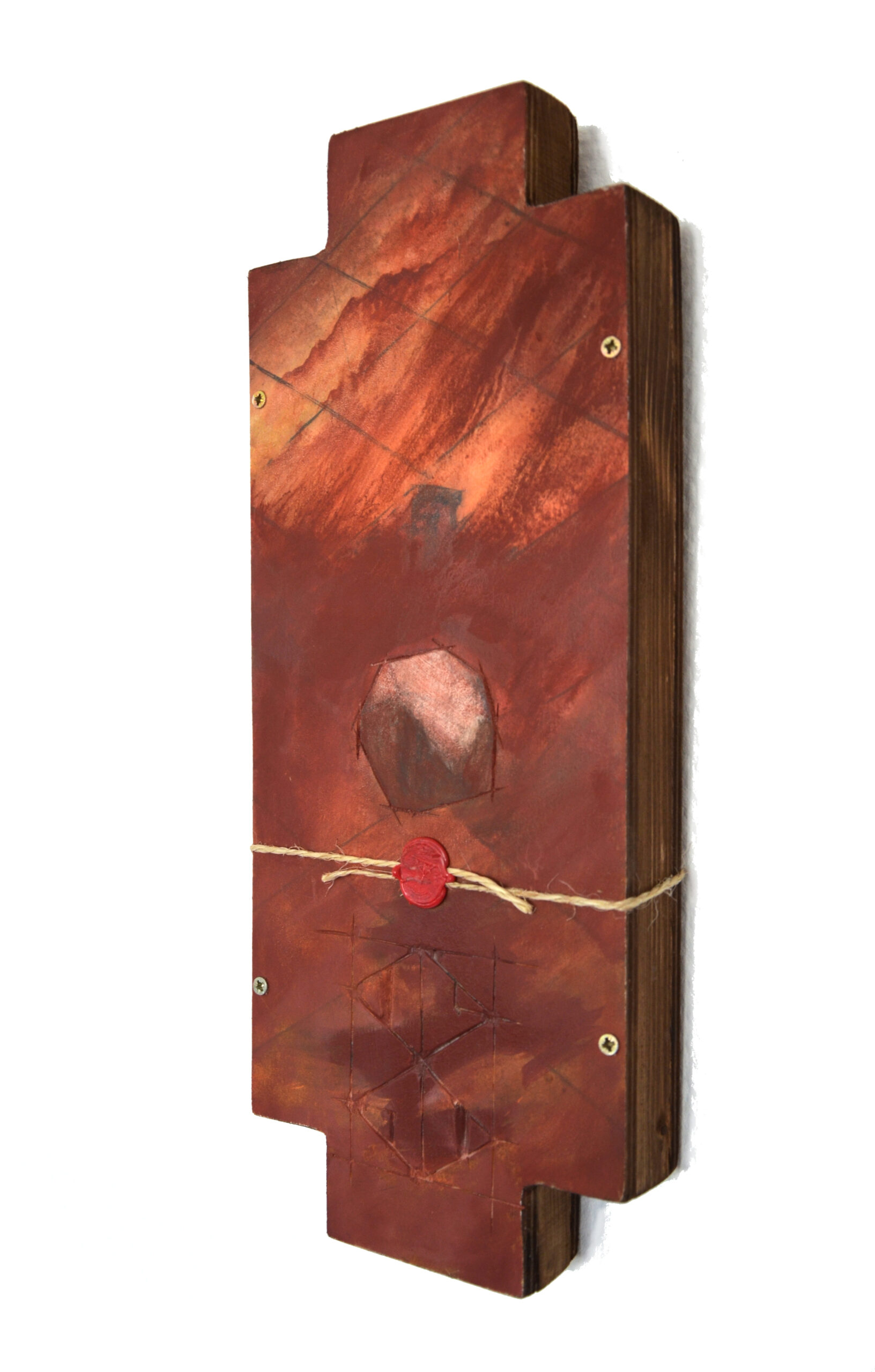
Dipinto a olio su pannello di compensato inciso / Oil on engraved plywood / Ölgemälde auf gravierter Sperrholzplatte
Instrumentum désigne un acte instrumentaire, à savoir le support d’un acte juridique, une preuve écrite, « authentique » en termes notariaux. Commençons par localiser le terme dans l’œuvre. Il figure en bas de la composition sous la forme d’un monogramme, c’est-à-dire la combinaison de plusieurs lettres sous la forme d’un chiffre (un symbole) : toutes les lettres du mot Instrumentum sont superposées et forment un chiffre. Ce chiffre est gravé. Au-dessus figure un volume, une sorte de polyèdre, en lévitation comme semble l’indiquer l’ombre peinte sous lui. Seuls les contours sont gravés. Au-dessus figure un troisième niveau, peint seulement, figurant une petite entrée dans une construction qui semble s’étendre sous terre. À l’arrière-plan, un paysage montagneux sert de contexte. Ce paysage est non seulement peint mais également léger, très dilué, comme aquarellé : nous sommes loin de l’entaille profonde du monogramme. Les couleurs sont par ailleurs plus brillantes, loin du caractère mat du monogramme.
Il y a donc deux pôles : la surface, la lumière, la fluidité en haut ; la profondeur, la densité, la solidité en bas. On retrouve une logique d’organisation des éléments dans la nature en même temps qu’un faisceau de qualités qui caractérise le travail artistique proposé ici. Reprenons : la surface de l’image est le domaine de la couleur fluide et de la nuance, de la peinture, à la manière des changements météorologiques ; les vicissitudes du temps court. La profondeur du support est le domaine de la gravure, de la forme solide dont le minimalisme s’accroît avec la profondeur. Plus le monogramme concentre de caractères, plus on peut y lire de mots différents. Le monogramme tend ainsi à devenir une matrice alphabétique contenant en puissance tout le vocabulaire imaginable. La profondeur est ainsi le domaine du potentiel, du concept ; c’est dans ce terreau que naissent les idées. Plus l’idée se développe, plus elle s’approche de sa réalisation concrète. Elle finit ainsi par naître et à parvenir à la surface de l’image, prenant ainsi la couleur d’un temps et d’un espace particuliers.
La boîte assume le caractère méthodologique que nous avons démontré et que soutient le titre. Seule boîte dépourvue de charnière dans cette série, elle est close comme un cercueil, une relique, vouée à retrancher de façon pérenne son contenu du regard, et à le laisser germer dans le terreau de l’imagination du regardeur, préservant ainsi la nature épurée et universelle de son principe.
Il termine «Instrumentum» indica un atto strumentale, ovvero il supporto di un atto giuridico, una prova scritta, «autentica» in termini notarili. Cominciamo con l’individuare il termine nell’opera. Esso figura nella parte inferiore della composizione sotto forma di monogramma, ovvero la combinazione di più lettere sotto forma di una cifra (un simbolo): tutte le lettere della parola Instrumentum sono sovrapposte e formano una cifra. Questa cifra è incisa. Sopra di essa figura un volume, una sorta di poliedro, in levitazione come sembra indicare l’ombra dipinta sotto di esso. Solo i contorni sono incisi. Sopra figura un terzo livello, solo dipinto, che raffigura un piccolo ingresso in una costruzione che sembra estendersi sottoterra. Sullo sfondo, un paesaggio montuoso fa da contesto. Questo paesaggio non solo è dipinto, ma è anche leggero, molto diluito, come acquerellato: siamo lontani dall’incisione profonda del monogramma. I colori sono inoltre più brillanti, lontani dal carattere opaco del monogramma.
Ci sono quindi due poli: la superficie, la luce, la fluidità in alto; la profondità, la densità, la solidità in basso. Ritroviamo una logica di organizzazione degli elementi presenti in natura insieme a un insieme di qualità che caratterizza l’opera artistica qui proposta. Riprendiamo: la superficie dell’immagine è il regno del colore fluido e della sfumatura, della pittura, alla maniera dei cambiamenti meteorologici; le vicissitudini del tempo breve. La profondità del supporto è il regno dell’incisione, della forma solida il cui minimalismo aumenta con la profondità. Più il monogramma concentra caratteri, più si possono leggere parole diverse. Il monogramma tende così a diventare una matrice alfabetica che contiene in potenza tutto il vocabolario immaginabile. La profondità è quindi il regno del potenziale, del concetto; è in questo terreno fertile che nascono le idee. Più l’idea si sviluppa, più si avvicina alla sua realizzazione concreta. Finisce così per nascere e raggiungere la superficie dell’immagine, assumendo così il colore di un tempo e di uno spazio particolari. La scatola assume il carattere metodologico che abbiamo dimostrato e che il titolo sostiene. Unica scatola priva di cerniere in questa serie, è chiusa come una bara, una reliquia, destinata a sottrarre in modo permanente il suo contenuto allo sguardo e a lasciarlo germogliare nel terreno fertile dell’immaginazione dello spettatore, preservando così la natura essenziale e universale del suo principio.
Instrumentum refers to an instrument, that is to say, the medium of a legal document, a written proof, ‘authentic’ in notarial terms. Let us begin by locating the term within the work. It appears at the bottom of the composition in the form of a monogram, that is to say, the combination of several letters in the form of a figure (a symbol): all the letters of the word Instrumentum are superimposed and form a figure. This figure is engraved. Above it is a volume, a sort of polyhedron, levitating as the shadow painted beneath it seems to indicate. Only the outlines are engraved. Above this is a third level, painted only, depicting a small entrance to a structure that appears to extend underground. In the background, a mountainous landscape serves as the setting. This landscape is not only painted but also light, very diluted, as if watercoloured: we are far removed from the deep engraving of the monogram. The colours are, moreover, brighter, far removed from the matt quality of the monogram.
There are thus two poles: the surface, light and fluidity at the top; depth, density and solidity at the bottom. We find a logic of organisation of elements found in nature, alongside a range of qualities that characterise the artistic work presented here. To recap: the surface of the image is the realm of fluid colour and nuance, of painting, much like changes in the weather; the vicissitudes of the fleeting moment. The depth of the medium is the realm of engraving, of solid form whose minimalism increases with depth. The more characters the monogram contains, the more different words can be read within it. The monogram thus tends to become an alphabetic matrix potentially containing the entire imaginable vocabulary. Depth is thus the realm of potential, of concept; it is in this fertile ground that ideas are born. The more the idea develops, the closer it comes to its concrete realisation. It thus eventually comes into being and reaches the surface of the image, taking on the colour of a particular time and space.
The box embodies the methodological character we have demonstrated and which the title supports. The only box in this series without a hinge, it is sealed like a coffin, a relic, destined to permanently shield its contents from view and allow them to germinate in the fertile ground of the viewer’s imagination, thus preserving the refined and universal nature of its principle.
„Instrumentum“ bezeichnet eine Urkunde, also den Träger eines Rechtsgeschäfts, einen schriftlichen Beweis, der im notariellen Sinne „authentisch“ ist. Beginnen wir damit, den Begriff im Werk zu lokalisieren. Er erscheint am unteren Rand der Komposition in Form eines Monogramms, also der Kombination mehrerer Buchstaben zu einer Ziffer (einem Symbol): Alle Buchstaben des Wortes „Instrumentum“ sind übereinandergelegt und bilden eine Ziffer. Diese Ziffer ist graviert. Darüber befindet sich ein Volumen, eine Art Polyeder, das zu schweben scheint, wie der darunter gemalte Schatten andeutet. Nur die Konturen sind graviert. Darüber befindet sich eine dritte Ebene, die nur gemalt ist und einen kleinen Eingang zu einem Bauwerk darstellt, das sich unterirdisch auszudehnen scheint. Im Hintergrund dient eine Berglandschaft als Kulisse. Diese Landschaft ist nicht nur gemalt, sondern auch leicht, sehr verwaschen, wie aquarelliert: Wir sind weit entfernt von der tiefen Gravur des Monogramms. Die Farben sind zudem leuchtender, weit entfernt vom matten Charakter des Monogramms.
Es gibt also zwei Pole: die Oberfläche, das Licht, die Fließendheit oben; die Tiefe, die Dichte, die Festigkeit unten. Wir finden hier eine Logik der Anordnung der Elemente in der Natur wieder, zugleich aber auch eine Reihe von Eigenschaften, die das hier vorgestellte künstlerische Werk charakterisieren. Fassen wir zusammen: Die Oberfläche des Bildes ist der Bereich der fließenden Farbe und der Nuancen, der Malerei, ähnlich den Wetterveränderungen; die Wechselfälle der kurzen Zeit. Die Tiefe des Trägers ist der Bereich der Gravur, der festen Form, deren Minimalismus mit der Tiefe zunimmt. Je mehr Zeichen das Monogramm konzentriert, desto mehr verschiedene Wörter lassen sich darin lesen. Das Monogramm tendiert somit dazu, zu einer alphabetischen Matrix zu werden, die potenziell das gesamte vorstellbare Vokabular enthält. Die Tiefe ist somit der Bereich des Potenzials, des Konzepts; in diesem Nährboden entstehen die Ideen. Je mehr sich die Idee entwickelt, desto mehr nähert sie sich ihrer konkreten Verwirklichung. So entsteht sie schließlich und gelangt an die Oberfläche des Bildes, wobei sie die Farbe einer bestimmten Zeit und eines bestimmten Raums annimmt. Die Schachtel nimmt den methodologischen Charakter an, den wir aufgezeigt haben und den der Titel untermauert. Als einzige Schachtel dieser Serie ohne Scharnier ist sie verschlossen wie ein Sarg, eine Reliquie, dazu bestimmt, ihren Inhalt dauerhaft dem Blick zu entziehen und ihn im Nährboden der Vorstellungskraft des Betrachters keimen zu lassen, wodurch die reine und universelle Natur ihres Prinzips bewahrt wird.
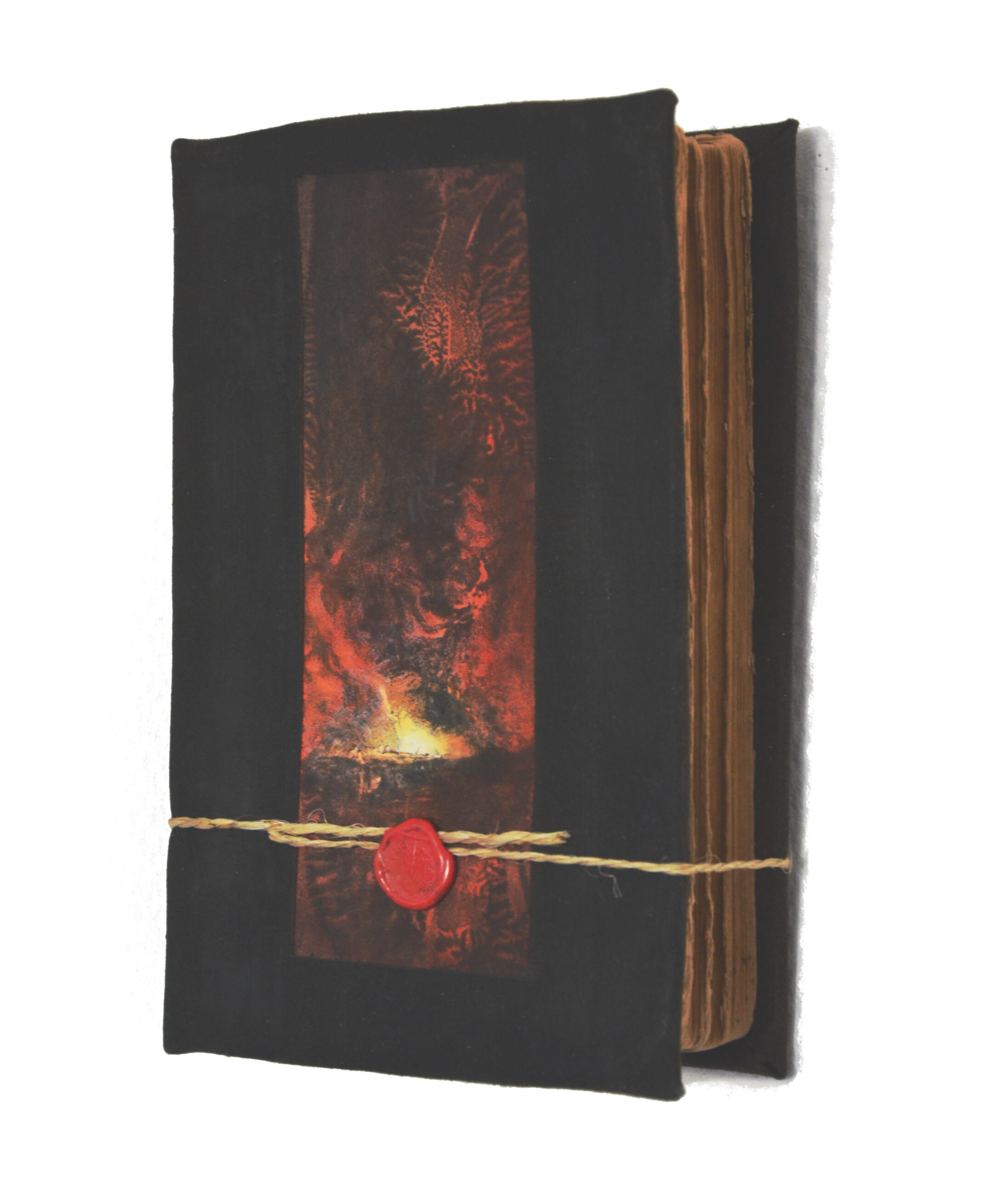
Monotipo goffrato su libro sigillato / Embossed monotype on a sealed book / Prägedruck auf versiegeltem Buch
« Droit de poursuivre en jugement ». Une autorisation de poursuite en justice assortie de l’image d’une explosion, il semble que ce travail traite d’un sujet contemporain : le droit international en contexte de guerre. L’image est en plan très large. Dans un ensemble presque entièrement abstrait, la ligne d’horizon dessine quelques silhouettes de constructions grâce à l’irradiation de l’explosion, nous donnant ainsi une idée de l’échelle des objets représentés. À mesure que l’on s’éloigne de l’explosion centrale, le paysage gagne en abstraction comme on l’a dit. Cette abstraction, confuse à la manière d’une explosion, prend parfois l’aspect de filaments, qui tissent le chaos dans un motif plus cohérent, grâce à la direction que donnent les filaments. Ces filaments servent ainsi de métaphores du sens retrouvé dans le chaos. Ce sens est retrouvé assez haut dans le ciel, ainsi que sous la ligne d’horizon, en tous cas loin de la singularité de l’événement représenté. C’est qu’une prise de recul est nécessaire pour percevoir le sens de la catastrophe individuelle. De l’intérieur, la guerre est un enfer particulier. De l’extérieur, elle s’inscrit dans un réseau d’intérêts et de puissances. Évidemment ceux pour qui sert la guerre sont loin des explosions dont ils sont à l’origine.
La lumière isolée de la catastrophe individuelle renseigne ainsi l’ensemble, dans une logique presque journalistique : certaines approches traitent le fait général par l’intermédiaire de témoignages individuels, ne serait-ce que pour une vertu illustrative… au risque d’instrumentalisations comme autant d’arbres qui cachent la forêt.
Ici, outre le rapport entre particularité et sens global, se dessine également une forme abstraite, en relief, embossée dans l’image. Une forme semble ainsi saillir depuis l’intérieur du livre, au milieu de l’image, au-dessus de l’explosion, comme si elle avait partie liée avec elle, peut-être en est-elle-même à l’origine. Cette forme est une étoile, qui rappelle la déflagration du sujet, mais une étoile noire, et au centre spiralaire. Deux aspects qui évoquent les propriétés d’un trou noir. Quelles sont les autres propriétés d’un trou noir ? Sa masse d’une immensité telle qu’elle attire à elle ce qui l’entoure, en somme une force implacable de concentration. Des entités isolées qui ont acquis une telle puissance qu’elles détruisent ou engloutissent ce qui les entoure—une dynamique qui n’est pas sans rappeler quelque question géopolitique actuelle.
«Diritto di intentare un’azione legale». Un’autorizzazione a procedere in giudizio accompagnata dall’immagine di un’esplosione: sembra che quest’opera affronti un tema contemporaneo: il diritto internazionale in contesto bellico. L’immagine è in campo molto largo. In un insieme quasi interamente astratto, la linea dell’orizzonte disegna alcune sagome di costruzioni grazie all’irradiazione dell’esplosione, dandoci così un’idea della scala degli oggetti rappresentati. Man mano che ci si allontana dall’esplosione centrale, il paesaggio acquista astrazione, come si è detto. Questa astrazione, confusa come un’esplosione, assume talvolta l’aspetto di filamenti che intrecciano il caos in un motivo più coerente, grazie alla direzione che i filamenti imprimono. Questi filamenti fungono così da metafore del senso ritrovato nel caos. Questo senso si ritrova piuttosto in alto nel cielo, così come sotto la linea dell’orizzonte, in ogni caso lontano dalla singolarità dell’evento rappresentato. È infatti necessario prendere le distanze per percepire il senso della catastrofe individuale. Dall’interno, la guerra è un inferno particolare. Dall’esterno, si inserisce in una rete di interessi e poteri. Ovviamente coloro per cui la guerra è utile sono lontani dalle esplosioni di cui sono all’origine.
La luce isolata della catastrofe individuale illumina così l’insieme, in una logica quasi giornalistica: alcuni approcci trattano il fatto generale attraverso testimonianze individuali, se non altro per una virtù illustrativa… a rischio di strumentalizzazioni come tanti alberi che nascondono la foresta. Qui, oltre al rapporto tra particolarità e senso globale, si delinea anche una forma astratta, in rilievo, impressa nell’immagine. Una forma sembra così sporgere dall’interno del libro, al centro dell’immagine, sopra l’esplosione, come se fosse legata ad essa, forse ne fosse essa stessa all’origine. Questa forma è una stella, che ricorda la deflagrazione del soggetto, ma una stella nera, con un centro a spirale. Due aspetti che evocano le proprietà di un buco nero. Quali sono le altre proprietà di un buco nero? La sua massa è di una tale immensità da attirare a sé ciò che lo circonda, in sostanza una forza implacabile di concentrazione. Entità isolate che hanno acquisito un tale potere da distruggere o inghiottire ciò che le circonda: una dinamica che non manca di richiamare alcune questioni geopolitiche attuali.
‘Right to take legal action’. A licence to take legal action accompanied by an image of an explosion; it seems that this work addresses a contemporary issue: international law in the context of war. The image is shot from a very wide angle. In an almost entirely abstract composition, the horizon line outlines a few silhouettes of buildings thanks to the blast’s radiance, thus giving us an idea of the scale of the objects depicted. As one moves away from the central explosion, the landscape becomes increasingly abstract, as mentioned. This abstraction, as chaotic as an explosion, sometimes takes the form of filaments, which weave the chaos into a more coherent pattern, thanks to the direction the filaments provide. These filaments thus serve as metaphors for the meaning rediscovered within the chaos. This meaning is found quite high in the sky, as well as below the horizon, in any case far from the singularity of the event depicted. The fact is that a step back is necessary to perceive the meaning of the individual catastrophe. From the inside, war is a particular hell. From the outside, it is part of a network of interests and powers. Obviously, those for whom the war serves are far removed from the explosions they have caused.
The isolated light of the individual catastrophe thus informs the whole, in an almost journalistic logic: certain approaches deal with the general reality through individual testimonies, if only for their illustrative value… at the risk of instrumentalisation, like so many trees that hide the forest.
Here, alongside the relationship between particularity and overall meaning, an abstract form also emerges, in relief, embossed within the image. A shape thus seems to protrude from within the book, in the centre of the image, above the explosion, as if it were connected to it, perhaps even its very cause. This shape is a star, reminiscent of the subject’s explosion, but a black star, with a spiral centre. Two aspects that evoke the properties of a black hole. What are the other properties of a black hole? Its mass is so immense that it draws everything around it towards itself—in short, an implacable force of concentration. Isolated entities that have acquired such power that they destroy or engulf their surroundings—a dynamic that is not unlike certain current geopolitical issues.
„Recht auf gerichtliche Verfolgung“. Eine Ermächtigung zur gerichtlichen Verfolgung, begleitet vom Bild einer Explosion – es scheint, als behandele diese Arbeit ein aktuelles Thema: das Völkerrecht im Kontext des Krieges. Das Bild ist sehr weitwinklig. In einem fast vollständig abstrakten Gesamtbild zeichnet die Horizontlinie dank der Ausbreitung der Explosion einige Silhouetten von Gebäuden nach und vermittelt uns so eine Vorstellung vom Maßstab der dargestellten Objekte. Je weiter man sich von der zentralen Explosion entfernt, desto abstrakter wird die Landschaft, wie bereits erwähnt. Diese Abstraktion, die wie eine Explosion unübersichtlich wirkt, nimmt manchmal die Form von Fäden an, die das Chaos dank der Richtung, die die Fäden vorgeben, zu einem kohärenteren Muster verweben. Diese Fäden dienen somit als Metaphern für den im Chaos wiedergefundenen Sinn. Dieser Sinn findet sich ziemlich hoch am Himmel sowie unterhalb der Horizontlinie, jedenfalls weit entfernt von der Einzigartigkeit des dargestellten Ereignisses. Denn es bedarf einer gewissen Distanz, um den Sinn der individuellen Katastrophe zu erfassen. Von innen betrachtet ist der Krieg eine ganz eigene Hölle. Von außen betrachtet fügt er sich in ein Geflecht aus Interessen und Mächten ein. Selbstverständlich sind diejenigen, denen der Krieg dient, weit entfernt von den Explosionen, die sie selbst ausgelöst haben.
Das isolierte Licht der individuellen Katastrophe beleuchtet so das Ganze, in einer fast journalistischen Logik: Bestimmte Ansätze behandeln das Allgemeine über individuelle Zeugnisse, und sei es nur um der Anschaulichkeit willen … auf die Gefahr hin, dass sie instrumentalisiert werden wie Bäume, die den Wald verdecken. Hier zeichnet sich neben dem Verhältnis zwischen Besonderheit und Gesamtbedeutung auch eine abstrakte Form ab, reliefartig, in das Bild eingeprägt. Eine Form scheint so aus dem Inneren des Buches hervorzutreten, in der Mitte des Bildes, über der Explosion, als ob sie mit ihr verbunden wäre, vielleicht ist sie sogar ihr Ursprung. Diese Form ist ein Stern, der an die Explosion des Motivs erinnert, aber ein schwarzer Stern mit spiralförmigem Zentrum. Zwei Aspekte, die an die Eigenschaften eines Schwarzen Lochs erinnern. Was sind die weiteren Eigenschaften eines Schwarzen Lochs? Seine Masse ist von solch unermesslicher Größe, dass sie alles um sich herum anzieht – kurz gesagt, eine unerbittliche Kraft der Konzentration. Isolierte Gebilde, die eine solche Macht erlangt haben, dass sie alles um sich herum zerstören oder verschlingen – eine Dynamik, die an gewisse aktuelle geopolitische Fragen erinnert.
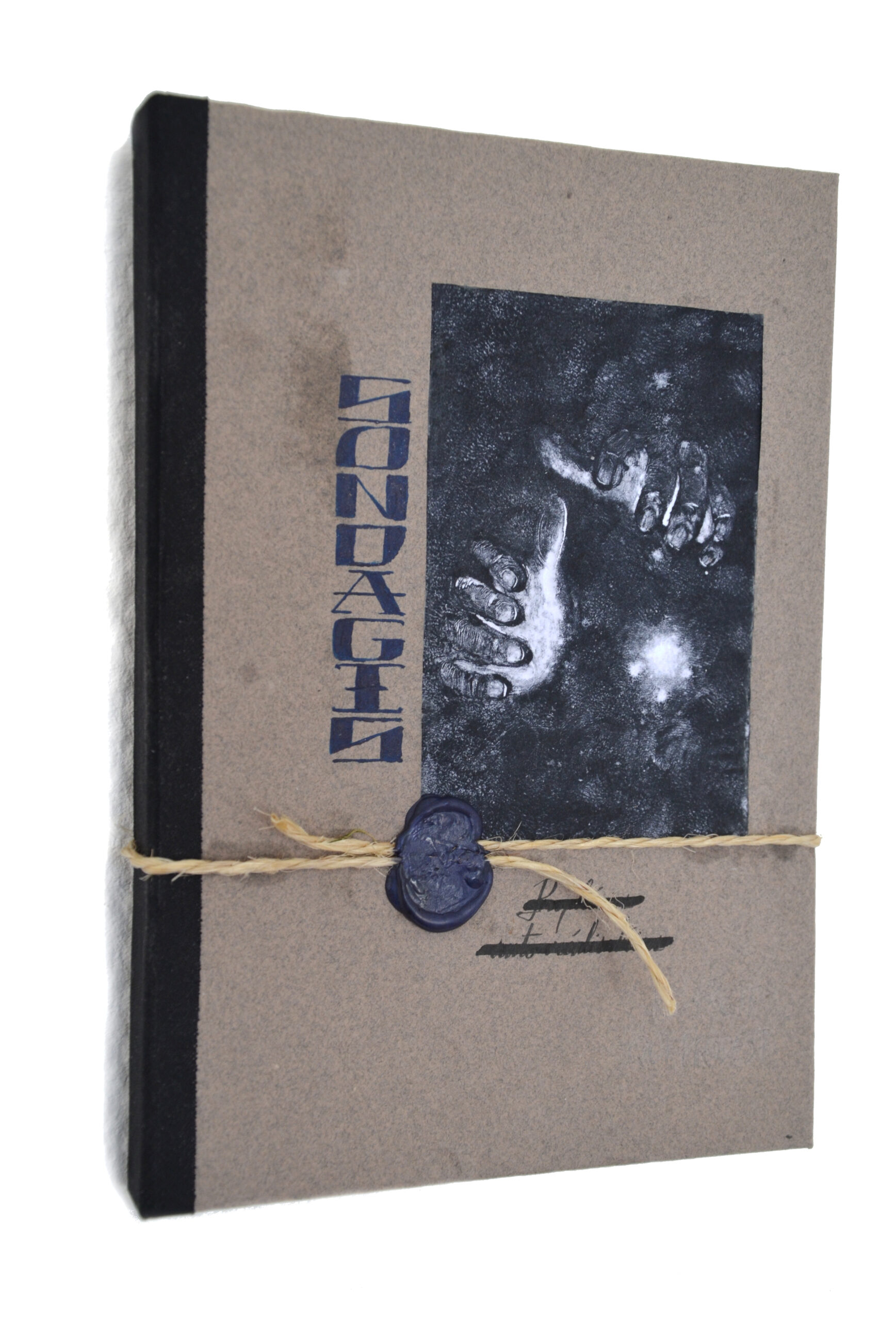
Monotipo su libro sigillato / Monotype on a sealed book / Monotypie auf versiegeltem Buch
« Celui-là a fait à qui la chose profite ». Le sceau paraît protéger le calcul opaque que désigne le titre, les sondages, au sujet duquel l’image fait un rapprochement avec la voyance. On ne voit d’ailleurs que les mains du voyant, comme s’il s’agissait d’un calcul plus guidé par un habile tour de main que par la raison. Irait-on jusqu’à parler de manipulation ? C’est ce qu’implique le titre Is fecit qui prodest, titre que l’on retrouve en bas à droite en gaufrage, furtif, comme une information confidentielle. Voilà donc le secret protégé par le sceau : cui bono ? À qui cela profite-t-il ?
Revenons sur l’opération en question, décrite par l’image. Les deux mains décrivent deux axes : un vertical, un horizontal, se rejoignent en angle droit. Nous sommes proches de l’abscisse et de l’ordonnée des statistiques qui sont la matière des sondages. L’ordonnée (le sujet d’étude), a un aspect juste, droit, rationnel : la main est posée de façon plus franche. En revanche, la main gauche (qui décrit l’abscisse, la donnée mesurée), est menaçante, plus proche de celle du marionnettiste que du statisticien. Le résultat de cette opération est un vague « nuage de points », matière statistique qui sera ensuite « interprétée » par un voyant… invisible.
«Chi ha fatto ciò ne trae vantaggio». Il sigillo sembra proteggere l’oscuro calcolo a cui allude il titolo, i sondaggi, che l’immagine mette in relazione con la chiaroveggenza. Si vedono infatti solo le mani del chiaroveggente, come se si trattasse di un calcolo guidato più da un abile gioco di mani che dalla ragione. Si potrebbe arrivare a parlare di manipolazione? È ciò che implica il titolo Is fecit qui prodest, titolo che si ritrova in basso a destra in rilievo, furtivo, come un’informazione riservata. Ecco quindi il segreto protetto dal sigillo: cui bono? A chi giova?
Torniamo all’operazione in questione, descritta dall’immagine. Le due mani descrivono due assi: uno verticale, uno orizzontale, che si incontrano ad angolo retto. Siamo vicini all’ascissa e all’ordinata delle statistiche che sono la materia dei sondaggi. L’ordinata (l’oggetto di studio) ha un aspetto giusto, retto, razionale: la mano è posata in modo più franco. Al contrario, la mano sinistra (che descrive l’ascissa, il dato misurato), è minacciosa, più vicina a quella del burattinaio che a quella dello statistico. Il risultato di questa operazione è una vaga «nube di punti», materia statistica che sarà poi «interpretata» da un veggente… invisibile.
‘He who does it benefits the one to whom it is of use’. The seal seems to shield the opaque calculation referred to in the title—the polls—which the image links to fortune-telling. Indeed, all we see are the fortune-teller’s hands, as if this calculation were guided more by a deft sleight of hand than by reason. Would one go so far as to speak of manipulation? This is what the title Is fecit qui prodest implies, a title found in the bottom right-hand corner in embossing, furtive, like confidential information. So here is the secret protected by the seal: cui bono? Who benefits from this?
Let us return to the operation in question, as depicted by the image. The two hands trace two axes: one vertical, one horizontal, meeting at a right angle. We are close to the x-axis and y-axis of the statistics that form the substance of surveys. The y-axis (the subject of study) has a fair, upright, rational aspect: the hand is positioned more directly. In contrast, the left hand (which describes the x-axis, the measured data) is threatening, more akin to that of a puppeteer than a statistician. The result of this operation is a vague ‘scatter plot’, statistical data that will then be ‘interpreted’ by an invisible seer…
„Derjenige hat es getan, dem es nützt“. Das Siegel scheint die undurchsichtige Berechnung zu schützen, auf die der Titel anspielt – die Umfragen –, wobei das Bild eine Verbindung zur Wahrsagerei herstellt. Man sieht übrigens nur die Hände des Wahrsagers, als handele es sich um eine Berechnung, die eher von einem geschickten Handgriff als von der Vernunft geleitet wird. Könnte man sogar von Manipulation sprechen? Das ist es, was der Titel „Is fecit qui prodest“ impliziert, ein Titel, der unten rechts als Prägung zu finden ist, versteckt, wie eine vertrauliche Information. Das ist also das durch das Siegel geschützte Geheimnis: cui bono? Wem nützt das? Kehren wir zu der im Bild dargestellten Handlung zurück. Die beiden Hände beschreiben zwei Achsen: eine vertikale und eine horizontale, die sich im rechten Winkel treffen. Wir befinden uns nahe an der Abszisse und der Ordinate der Statistiken, die Gegenstand von Umfragen sind. Die Ordinate (das Untersuchungsobjekt) wirkt korrekt, gerade, rational: Die Hand ist offener angelegt. Die linke Hand hingegen (die die Abszisse, die gemessenen Daten, beschreibt) wirkt bedrohlich, eher wie die eines Puppenspielers als die eines Statistikers. Das Ergebnis dieser Handlung ist eine vage „Punktwolke“, statistisches Material, das anschließend von einem unsichtbaren Hellseher „gedeutet“ wird.
FORCES
Forze
Forces
Stärken
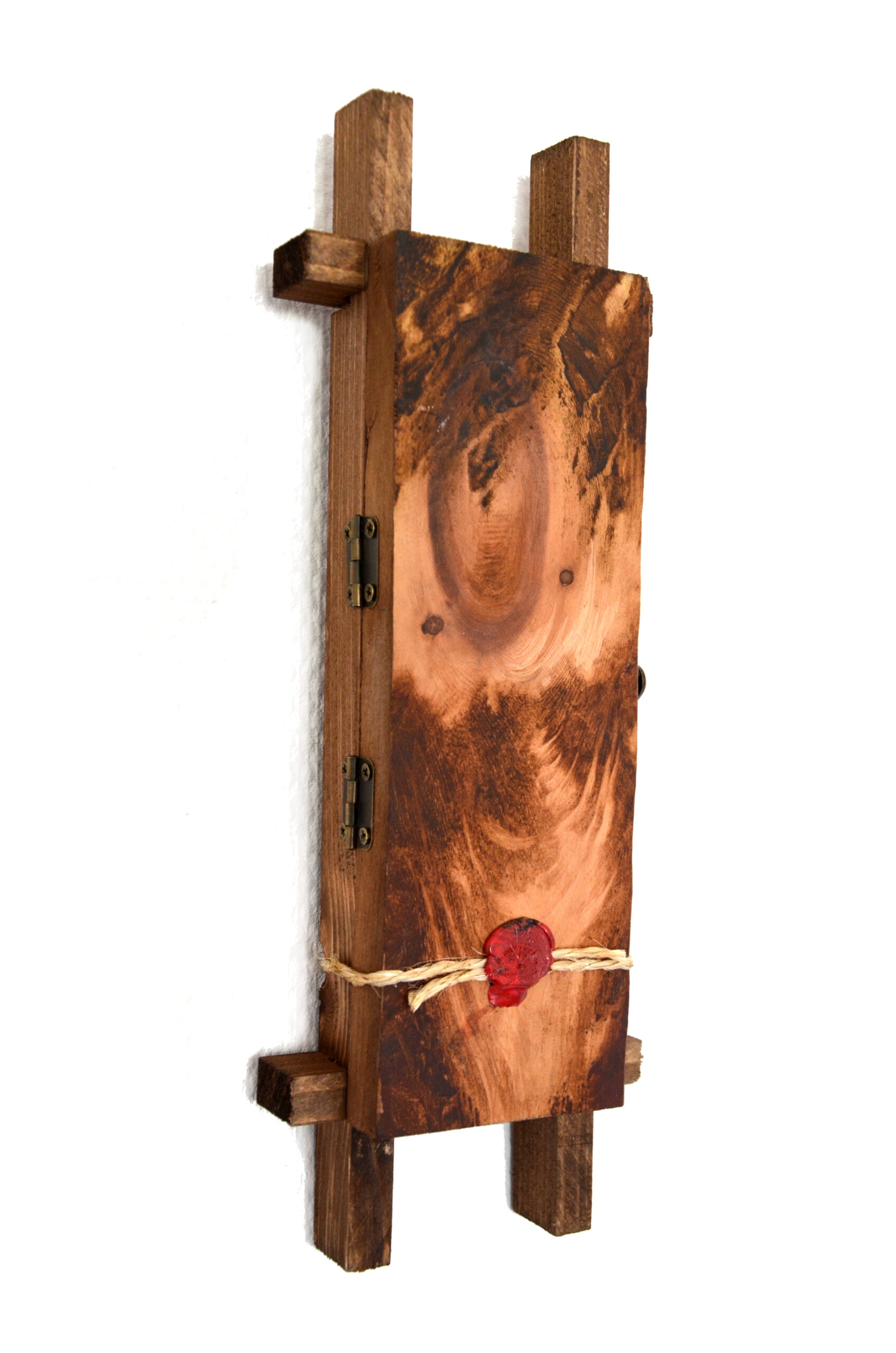
Olio su pino cembro inciso / Oil on engraved Swiss stone pine / Ölgemälde auf graviertem Zirbelkiefernholz
Cette sentence (« la loi est impérative ») orne le plafond de la Grand’ Chambre de la Cour de Cassation. Un de ses présidents l’interprète ainsi en 2010 : « La loi commande au juge, qui n’a qu’un devoir – l’appliquer dans sa lettre et dans son esprit ». Cette petite boîte est plus modeste qu’un plafond monumental, mais elle porte un message tout aussi intimidant. Le paysage impressionniste de son couvercle ébauche un monde mouvant, voire en état de liquéfaction ; la transformation du monde dans le cours du temps. Mais au centre trône, en guise d’astre, une forme oblongue, adjointe de deux satellites latéraux ; des piliers, des boussoles dans ce monde mouvant. La matière nous renseigne d’ailleurs d’elle-même : ces objets s’appuient sur la présence de nœuds dans le bois, or que sont les nœuds ? La marque de la croissance d’une branche à partir du tronc, c’est-à-dire la marque d’un axe perpendiculaire à celui du fil du bois ; ou en termes symboliques, la marque d’une transcendance au cœur d’un paysage représenté sur le plan du fil du bois.
La loi impérative est celle de points d’ancrage dans le réel de la nature, comme le sont ces nœuds qui tiennent lieu d’astres. Il peut suffire de prendre la mesure d’un astre, d’une montagne, de ces choses aussi immenses, inflexibles, implacables, pour se souvenir du caractère impérieux de la nature et de sa loi. Ce rappel à l’ordre ainsi fait, il nous incombe d’en déduire sa mise en application, « dans sa lettre et dans son esprit ».
Questa massima («la legge è imperativa») adorna il soffitto della Grand’Chambre della Corte di Cassazione. Uno dei suoi presidenti la interpretò così nel 2010: «La legge impone al giudice, che ha un solo dovere: applicarla nella lettera e nello spirito». Questa piccola scatola è più modesta di un soffitto monumentale, ma porta un messaggio altrettanto intimidatorio. Il paesaggio impressionista del suo coperchio abbozza un mondo in movimento, quasi in stato di liquefazione; la trasformazione del mondo nel corso del tempo. Ma al centro troneggia, come un astro, una forma oblunga, affiancata da due satelliti laterali; pilastri, bussole in questo mondo mutevole. La materia ci informa del resto di sé stessa: questi oggetti si basano sulla presenza di nodi nel legno, ma cosa sono i nodi? Il segno della crescita di un ramo a partire dal tronco, cioè il segno di un asse perpendicolare a quello della venatura del legno; o in termini simbolici, il segno di una trascendenza nel cuore di un paesaggio rappresentato sul piano della venatura del legno. La legge imperativa è quella dei punti di ancoraggio nella realtà della natura, come lo sono questi nodi che fungono da astri. Può bastare prendere la misura di un astro, di una montagna, di queste cose così immense, inflessibili, implacabili, per ricordare il carattere imperioso della natura e della sua legge. Una volta fatto questo richiamo all’ordine, spetta a noi dedurne l’applicazione, «nella lettera e nello spirito».
This maxim (“the law is imperative”) adorns the ceiling of the Grand Chamber of the Court of Cassation. One of its presidents interpreted it as follows in 2010: “The law commands the judge, who has but one duty – to apply it to the letter and in spirit.” This small box is more modest than a monumental ceiling, yet it carries a message just as daunting. The Impressionist landscape on its lid sketches a shifting world, even one in a state of liquefaction; the transformation of the world over time. But at the centre, like a star, sits an oblong shape, flanked by two lateral satellites; pillars, compasses in this shifting world. The material itself tells us something: these objects are based on the presence of knots in the wood, but what are knots? The mark of a branch’s growth from the trunk, that is to say, the mark of an axis perpendicular to that of the wood grain; or in symbolic terms, the mark of a transcendence at the heart of a landscape represented on the plane of the wood grain. The imperative law is that of anchor points in the reality of nature, such as these knots which take the place of stars. It may suffice to take the measure of a star, a mountain, of these things too immense, inflexible, implacable, to recall the imperious nature of nature and its law. Having thus been brought to order, it falls to us to deduce its application, ‘in letter and in spirit’.
Dieser Satz („Das Gesetz ist unumstößlich“) ziert die Decke des Großen Saals des Kassationsgerichtshofs. Einer seiner Präsidenten interpretierte ihn 2010 wie folgt: „Das Gesetz gebietet dem Richter, der nur eine Pflicht hat – es nach Buchstaben und Geist anzuwenden.“ Diese kleine Schachtel ist bescheidener als eine monumentale Decke, doch sie trägt eine ebenso einschüchternde Botschaft. Die impressionistische Landschaft auf ihrem Deckel skizziert eine sich wandelnde Welt, ja sogar eine Welt im Zustand der Verflüssigung; die Verwandlung der Welt im Laufe der Zeit. Doch in der Mitte thront wie ein Gestirn eine längliche Form, flankiert von zwei seitlichen Satelliten; Säulen, Kompasse in dieser sich wandelnden Welt. Das Material verrät uns übrigens selbst etwas über sich: Diese Objekte stützen sich auf die Anwesenheit von Astlöchern im Holz, doch was sind Astlöcher? Das Zeichen des Wachstums eines Astes vom Stamm aus, das heißt das Zeichen einer Achse, die senkrecht zur Maserung des Holzes verläuft; oder symbolisch ausgedrückt: das Zeichen einer Transzendenz im Herzen einer Landschaft, die auf der Ebene der Holzmaserung dargestellt ist. Das zwingende Gesetz ist das der Verankerungspunkte in der Realität der Natur, wie es diese Astlöcher sind, die anstelle von Himmelskörpern stehen. Es kann genügen, das Ausmaß eines Himmelskörpers, eines Berges, dieser ebenso unermesslichen, unnachgiebigen, unerbittlichen Dinge zu ermessen, um sich an den gebieterischen Charakter der Natur und ihres Gesetzes zu erinnern. Nachdem diese Mahnung ausgesprochen ist, obliegt es uns, ihre Umsetzung abzuleiten, „nach Buchstaben und Geist“.
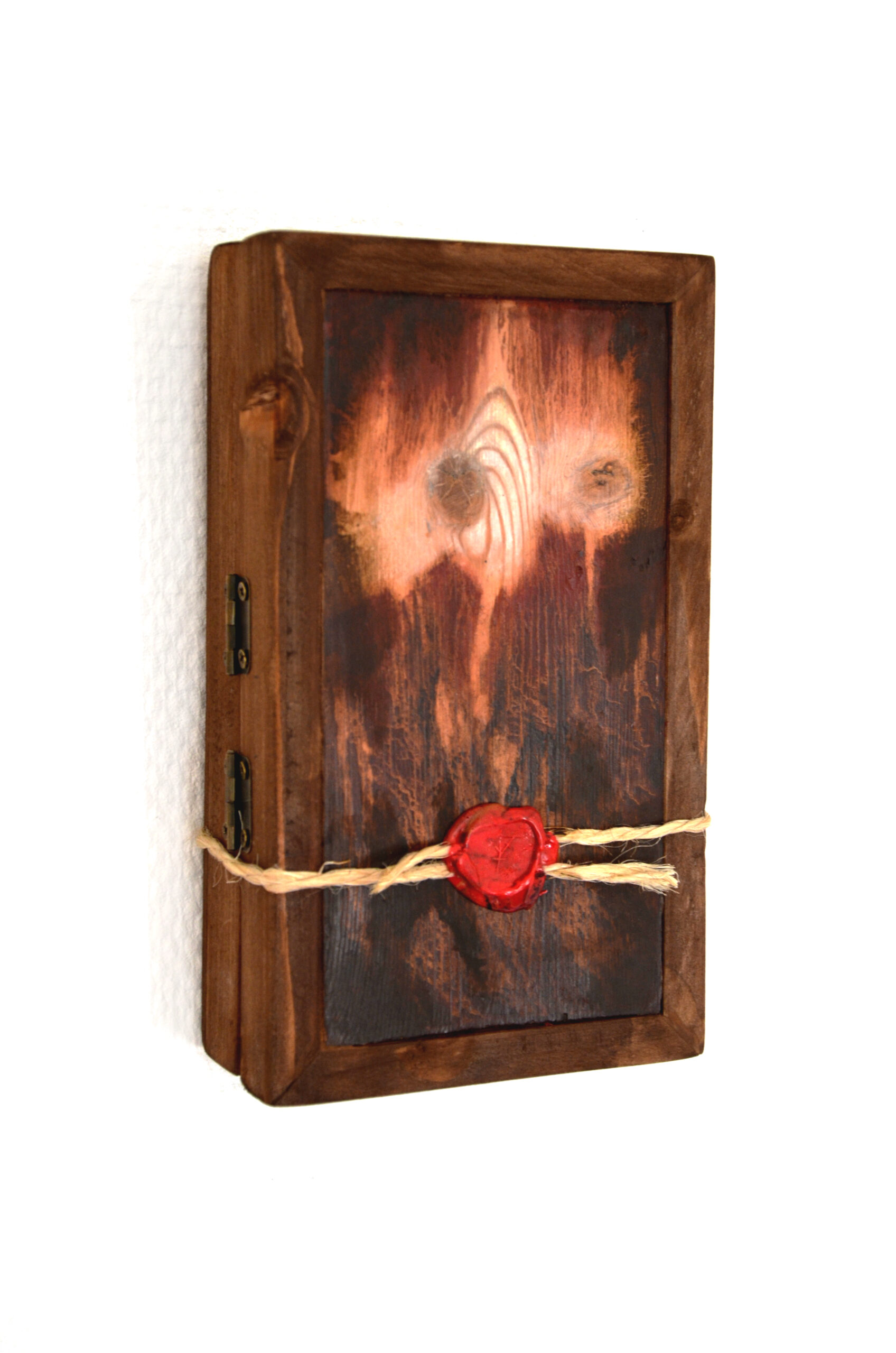
Olio su pino cembro / Oil on Swiss stone pine / Ölgemälde auf Zirbelkiefernholz
« Du moins au plus », c’est-à-dire l’extension du texte à une situation différente, avec une même raison d’être à un niveau supérieur. La concaténation des échelles impliquée par la sentence appelle une lecture existentielle. L’ensemble du travail exposé ici consiste à tourner le regard vers l’immensité à partir des petites lucarnes que constituent ces volumes scellés. C’est particulièrement le cas avec cette boîte, qui présente une multitude de filaments minuscules qui animent la partie terrestre d’un paysage abstrait. Le détail n’est pas dans le dessin mais dans la texture, comme pour encourager un regard sur la substance du monde plutôt que d’en étudier une parcelle. À l’horizon, la texture des filaments rejoint celle du veinage du bois, qui notamment grâce au nœud central qui tient lieu d’astre, élargit le trait depuis les filaments liquides infinitésimaux de la terre vers de larges courbes amplifiées par la couleur claire de la partie céleste. À partir de cet astre, les lignes obéissent à la logique du veinage, trouvent ainsi leur orientation, et semblent rayonner. Ainsi se fait le relais du particulier au global, du microcosme au macrocosme. Pour qui parvient à percevoir la direction de l’infiniment petit et de l’infiniment grand, le mystère amplifie la beauté (le « sublime », pour utiliser le terme précis) et vice-versa : c’est cela que renferme ce sceau.
«Dal meno al più», ovvero l’estensione del testo a una situazione diversa, con la stessa ragion d’essere a un livello superiore. La concatenazione delle scale implicita nella frase richiede una lettura esistenziale. L’insieme dell’opera qui esposta consiste nel rivolgere lo sguardo verso l’immensità partendo dalle piccole finestre che costituiscono questi volumi sigillati. È particolarmente vero per questa scatola, che presenta una moltitudine di filamenti minuscoli che animano la parte terrestre di un paesaggio astratto. Il dettaglio non sta nel disegno ma nella texture, quasi a incoraggiare uno sguardo sulla sostanza del mondo piuttosto che sullo studio di una sua porzione. All’orizzonte, la trama dei filamenti si unisce a quella delle venature del legno, che, grazie in particolare al nodo centrale che funge da astro, allarga il tratto dai filamenti liquidi infinitesimali della terra verso ampie curve amplificate dal colore chiaro della parte celeste. A partire da questo astro, le linee obbediscono alla logica delle venature, trovano così il loro orientamento e sembrano irradiarsi. Si compie così il passaggio dal particolare al globale, dal microcosmo al macrocosmo. Per chi riesce a percepire la direzione dell’infinitamente piccolo e dell’infinitamente grande, il mistero amplifica la bellezza (il «sublime», per usare il termine preciso) e viceversa: è questo che racchiude questo sigillo.
‘From the least to the greatest’—that is to say, the extension of the text to a different situation, with the same underlying purpose at a higher level. The concatenation of scales implied by the maxim calls for an existential reading. The body of work exhibited here consists of turning one’s gaze towards immensity through the small windows formed by these sealed volumes. This is particularly the case with this box, which features a multitude of tiny filaments that animate the terrestrial part of an abstract landscape. The detail lies not in the drawing but in the texture, as if to encourage a gaze upon the substance of the world rather than studying a single fragment of it. On the horizon, the texture of the filaments merges with that of the wood grain, which—notably thanks to the central knot serving as a star—extends the line from the infinitesimal liquid filaments of the earth towards broad curves amplified by the light colour of the celestial portion. From this star, the lines follow the logic of the grain, thus finding their direction, and appear to radiate. Thus is the transition made from the particular to the universal, from the microcosm to the macrocosm. For those who can perceive the direction of the infinitely small and the infinitely large, mystery amplifies beauty (the ‘sublime’, to use the precise term) and vice versa: this is what this seal contains.
„Vom Geringsten zum Größten“, das heißt die Ausweitung des Textes auf eine andere Situation, mit demselben Daseinsgrund auf einer höheren Ebene. Die durch den Satz implizierte Verknüpfung der Ebenen erfordert eine existenzielle Lesart. Die Gesamtheit der hier ausgestellten Arbeiten besteht darin, den Blick von den kleinen Fensteröffnungen, die diese versiegelten Volumen bilden, auf die Unendlichkeit zu richten. Dies gilt insbesondere für diese Schachtel, die eine Vielzahl winziger Fäden aufweist, die den irdischen Teil einer abstrakten Landschaft beleben. Das Detail liegt nicht in der Zeichnung, sondern in der Textur, als wolle man den Blick auf die Substanz der Welt lenken, anstatt nur einen Ausschnitt davon zu untersuchen. Am Horizont verschmilzt die Textur der Fäden mit der Maserung des Holzes, die insbesondere dank des zentralen Knotens, der als Gestirn fungiert, die Linie von den winzigen, fließenden Fäden der Erde hin zu weiten Kurven erweitert, die durch die helle Farbe des himmlischen Teils verstärkt werden. Ausgehend von diesem Gestirn folgen die Linien der Logik der Maserung, finden so ihre Ausrichtung und scheinen zu strahlen. So vollzieht sich der Übergang vom Besonderen zum Allgemeinen, vom Mikrokosmos zum Makrokosmos. Für den, der die Richtung des unendlich Kleinen und des unendlich Großen wahrnehmen kann, verstärkt das Geheimnis die Schönheit (das „Erhabene“, um den präzisen Begriff zu verwenden) und umgekehrt: Das ist es, was dieses Siegel in sich birgt.
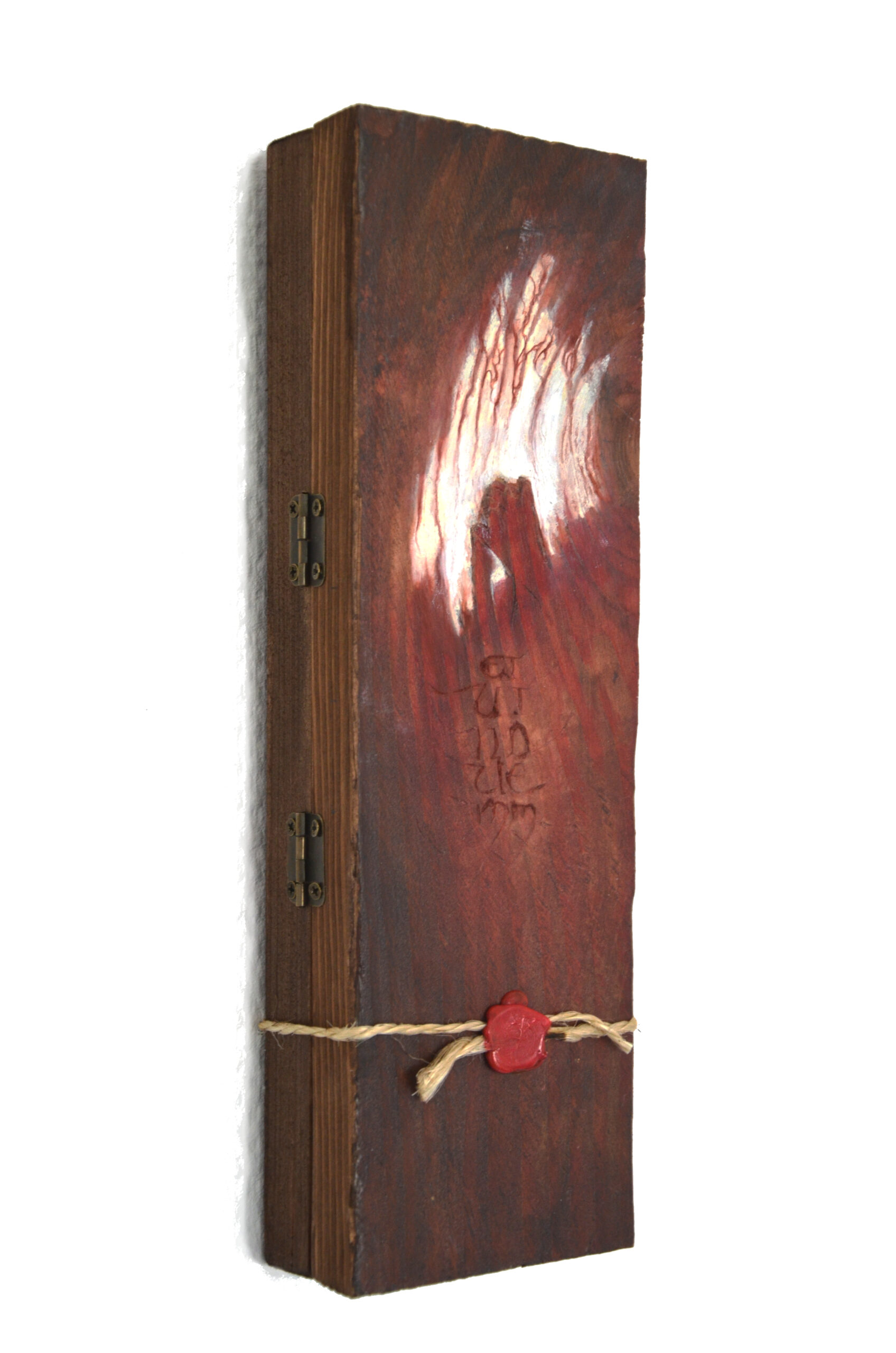
Olio su abete inciso / Oil on engraved fir / Ölgemälde auf graviertem Tannenholz
Unum et idem, « une seule et même chose ». Comme dans A Minori ad majus et Lex Imperat, le veinage est partie intégrante de la composition. À première vue, il s’agit d’amplifier le dynamisme de ce qui ressemble à un éperon rocheux percé, le long d’une crête, sur un fond de ciel très clair. Mais en regardant le détail, la peinture n’est pas le seul vecteur de sens. Le bois est gravé à l’endroit de l’éperon et esquisse le contour de deux mains levées et jointes. Si l’on longe la crête vers le haut, le veinage est souligné, et mène au nœud, au centre du rayonnement du veinage, dont la forme circulaire pourrait tenir lieu d’auréole autour d’une tête située hors-champ. C’est ainsi un paysage anthropomorphe que nous voyons ici, dans la combinaison de la prière avec la montagne, ce qui donne sens à la sentence Unum et idem du titre. La sentence est d’ailleurs gravée au centre de l’image, sous la forme combinant l’éperon rocheux et les mains jointes, avec des caractères aux très longs empattements qui se perdent dans l’image, comme pour souligner cette fusion. La boîte garde sous scellé la question philosophique suivante : cette fusion entre prière et montagne signifie-t-elle une identité entre la Nature et Dieu ?
Unum et idem, «una sola e stessa cosa». Come in A Minori ad majus e Lex Imperat, le venature del legno sono parte integrante della composizione. A prima vista, si tratta di amplificare il dinamismo di ciò che sembra uno sperone roccioso perforato, lungo una cresta, su uno sfondo di cielo molto chiaro. Ma osservando i dettagli, la pittura non è l’unico vettore di significato. Il legno è inciso nel punto dello sperone e delinea il contorno di due mani alzate e giunte. Se si risale lungo la cresta, le venature sono accentuate e conducono al nodo, al centro della radiazione delle venature, la cui forma circolare potrebbe fungere da aureola attorno a una testa situata fuori campo.
È quindi un paesaggio antropomorfo quello che vediamo qui, nella combinazione della preghiera con la montagna, il che dà senso alla frase Unum et idem del titolo. La frase è del resto incisa al centro dell’immagine, sotto forma di una combinazione tra lo sperone roccioso e le mani giunte, con caratteri dalle grazie molto lunghe che si perdono nell’immagine, quasi a sottolineare questa fusione. La scatola custodisce sotto sigillo la seguente questione filosofica: questa fusione tra preghiera e montagna significa un’identità tra la Natura e Dio?
Unum et idem, ‘one and the same thing’. As in A Minori ad majus and Lex Imperat, the grain of the wood forms an integral part of the composition. At first glance, the aim is to amplify the dynamism of what resembles a jagged rocky outcrop, along a ridge, against a backdrop of a very clear sky. But on closer inspection, the paint is not the sole vehicle of meaning. The wood is carved at the point of the outcrop, sketching the outline of two raised, clasped hands. If one follows the ridge upwards, the grain is emphasised, leading to the knot at the centre of the radiating grain, whose circular shape could serve as a halo around a head situated off-screen.
It is thus an anthropomorphic landscape that we see here, in the combination of prayer with the mountain, which gives meaning to the phrase Unum et idem in the title. The phrase is, moreover, engraved at the centre of the image, in a form combining the rocky outcrop and clasped hands, with characters featuring very long serifs that fade into the image, as if to emphasise this fusion. The box holds the following philosophical question under seal: does this fusion between prayer and the mountain signify an identity between Nature and God?
Unum et idem, „ein und dasselbe“. Wie in „A Minori ad majus“ und „Lex Imperat“ ist die Maserung integraler Bestandteil der Komposition. Auf den ersten Blick geht es darum, die Dynamik dessen zu verstärken, was wie ein durchbrochener Felsvorsprung entlang eines Bergrückens vor einem sehr hellen Himmelshintergrund aussieht. Bei genauerer Betrachtung ist jedoch nicht nur die Malerei der einzige Bedeutungsträger. Das Holz ist an der Stelle des Felsvorsprungs graviert und skizziert die Umrisse zweier erhobener und gefalteter Hände. Folgt man dem Kamm nach oben, wird die Maserung hervorgehoben und führt zum Astknoten, zum Zentrum der Ausstrahlung der Maserung, dessen kreisförmige Form als Heiligenschein um einen außerhalb des Bildausschnitts befindlichen Kopf dienen könnte. So sehen wir hier eine anthropomorphe Landschaft, in der sich das Gebet mit dem Berg verbindet, was dem Titel „Unum et idem“ seine Bedeutung verleiht. Der Satz ist übrigens in der Bildmitte eingraviert, in einer Form, die den Felsvorsprung und die gefalteten Hände vereint, mit Schriftzeichen mit sehr langen Serifen, die sich im Bild verlieren, als wolle man diese Verschmelzung unterstreichen. Die Schatulle bewahrt die folgende philosophische Frage unter Verschluss: Bedeutet diese Verschmelzung von Gebet und Berg eine Identität zwischen Natur und Gott?
OBLIGATIONS
Obblighi
Obligations
Verpflichtungen
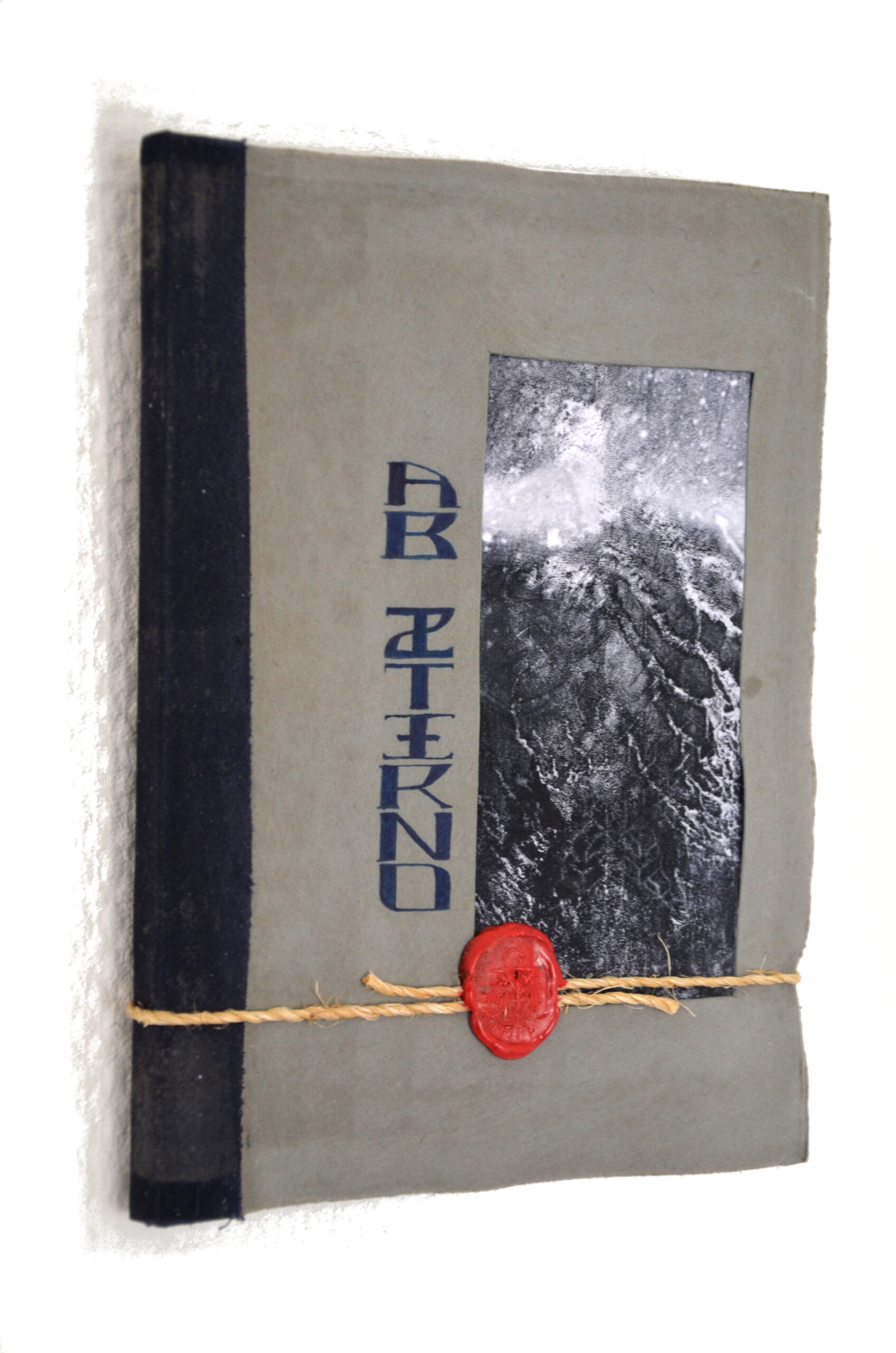
incisione su lattina di alluminio, monotipo su libro sigillato / engraving on an aluminium can, a unique print on a sealed book / Radierung auf einer Aluminiumdose, als Einzelabzug auf einem versiegelten Buch
Ab Aeterno : « Depuis la nuit des temps ». La formule se retrouve tout au long de la Bible, et avec une grande concision, dirige la pensée vers quelque chose de lointain, de vaste, voire d’abyssal, pour qui s’intéresse à cet objet et le médite.
L’objectif des artistes du sublime est justement de donner à voir de grandes échelles. Pas de grande échelle ici, dans ce modeste format de vingt par quinze centimètres, mais la représentation en petit format d’un paysage montagneux presque abstrait. Le cadre offert par le modeste format du livre est une lucarne vers la grandeur, comme un modeste ex voto empreint de révérence.
L’humilité se retrouve dans le moyen d’exécution : l’image est le produit d’une gravure à la vis sur une canette en aluminium. La canette gravée a servi de matrice traitée comme un monotype pour produire une estampe. L’image qui en résulte fourmille de détails. Le ciel est moucheté de microgouttelettes, dans une texture irrégulière, et la montagne s’anime d’une texture complexe dans laquelle se mêlent des empreintes digitales et des filaments de diluant. Ainsi, même la petitesse du format fait percevoir le macrocosme par le biais du microcosme.
Or, ce traitement monotypé révèle autre chose qu’un relief montagneux. La texture révèle un motif discret, celui de la gravure à la vis. Ainsi, outre les lignes nerveuses de la texture se devine une forme bien plus géométrique, symétrique, au centre de l’image, mais presque subliminal. Il semble ainsi que la montagne recèle en elle, en son sein ou à sa racine, une structure d’ordre architecturale, une géométrie sacrée, codée génétiquement « depuis la nuit des temps », qui parfois guide les filaments de la texture en surface, comme l’on ne perçoit qu’en des traces subtiles l’harmonie fascinante de la nature au cœur de la broussaille à l’apparence la plus confuse.
Ab Aeterno: «Sin dai tempi immemorabili». Questa espressione ricorre in tutta la Bibbia e, con grande concisione, orienta il pensiero verso qualcosa di lontano, di vasto, persino di abissale, per chi si interessa a questo tema e lo medita.
L’obiettivo degli artisti del sublime è proprio quello di mostrare grandi dimensioni. Nessuna grande dimensione qui, in questo modesto formato di venti per quindici centimetri, ma la rappresentazione in piccolo formato di un paesaggio montuoso quasi astratto. La cornice offerta dal modesto formato del libro è una finestra sulla grandezza, come un modesto ex voto intriso di riverenza.
L’umiltà si ritrova nel mezzo di esecuzione: l’immagine è il prodotto di un’incisione a vite su una lattina di alluminio. La lattina incisa è servita da matrice trattata come un monotipo per produrre una stampa. L’immagine che ne risulta pullula di dettagli. Il cielo è punteggiato da microgoccioline, in una trama irregolare, e la montagna si anima di una trama complessa in cui si mescolano impronte digitali e filamenti di diluente. Così, anche la piccolezza del formato fa percepire il macrocosmo attraverso il microcosmo.
Tuttavia, questa lavorazione monotipica rivela qualcosa di più di un rilievo montuoso. La trama rivela un motivo discreto, quello dell’incisione a vite. Così, oltre alle linee nervose della trama, si intuisce una forma ben più geometrica, simmetrica, al centro dell’immagine, ma quasi subliminale. Sembra quindi che la montagna nasconda in sé, nel suo seno o alle sue radici, una struttura di ordine architettonico, una geometria sacra, codificata geneticamente «sin dalla notte dei tempi», che talvolta guida i filamenti della trama in superficie, così come si percepisce solo in tracce sottili l’affascinante armonia della natura nel cuore della boscaglia dall’aspetto più confuso.
Ab Aeterno: ‘Since time immemorial’. The phrase recurs throughout the Bible and, with great conciseness, directs the mind towards something distant, vast, even abyssal, for those who take an interest in this subject and reflect upon it.
The aim of artists of the sublime is precisely to reveal grand scales. There is no grand scale here, in this modest format of twenty by fifteen centimetres, but rather a small-scale representation of an almost abstract mountainous landscape. The frame provided by the book’s modest format is a window onto grandeur, like a humble votive offering imbued with reverence.
Humility is evident in the method of execution: the image is the product of a screw engraving on an aluminium can. The engraved can served as a matrix, treated as a monotype to produce a print. The resulting image is teeming with detail. The sky is speckled with micro-droplets, in an irregular texture, and the mountain comes to life with a complex texture in which fingerprints and strands of thinner intermingle. Thus, even the smallness of the format allows the macrocosm to be perceived through the microcosm.
However, this monotype treatment reveals something other than a mountainous relief. The texture reveals a subtle motif, that of screw engraving. Thus, beyond the nervous lines of the texture, one can discern a far more geometric, symmetrical form at the centre of the image, though almost subliminal. It thus seems that the mountain conceals within itself, in its heart or at its root, a structure of an architectural order, a sacred geometry, genetically encoded ‘since the dawn of time’, which at times guides the filaments of the surface texture, just as one perceives only in subtle traces the fascinating harmony of nature at the heart of the most seemingly chaotic undergrowth.
Ab Aeterno: „Seit Anbeginn der Zeit“. Dieser Ausdruck taucht immer wieder in der Bibel auf und lenkt die Gedanken – in aller Kürze – auf etwas Fernes, Weites, ja sogar Abgrundtiefes, für diejenigen, die sich dafür interessieren und darüber nachdenken.
Das Ziel der Künstler des Erhabenen ist es gerade, große Maßstäbe sichtbar zu machen. Hier gibt es keinen großen Maßstab, in diesem bescheidenen Format von zwanzig mal fünfzehn Zentimetern, sondern die Darstellung einer fast abstrakten Berglandschaft im Kleinformat. Der Rahmen, den das bescheidene Format des Buches bietet, ist ein Fenster zur Größe, wie ein bescheidenes, von Ehrfurcht geprägtes Votivbild.
Die Bescheidenheit zeigt sich in der Ausführungsweise: Das Bild ist das Ergebnis einer Schraubgravur auf einer Aluminiumdose. Die gravierte Dose diente als Matrize, die wie ein Monotyp behandelt wurde, um einen Druck herzustellen. Das daraus resultierende Bild wimmelt nur so von Details. Der Himmel ist mit Mikrotropfen übersät, in einer unregelmäßigen Textur, und der Berg wird durch eine komplexe Textur belebt, in der sich Fingerabdrücke und Verdünnungsmittelstränge vermischen. So lässt selbst das kleine Format den Makrokosmos durch den Mikrokosmos wahrnehmen. Diese Monotypie-Bearbeitung offenbart jedoch mehr als nur ein bergiges Relief. Die Textur enthüllt ein dezentes Motiv, das der Schraubenradgravur. So lässt sich neben den nervösen Linien der Textur eine weitaus geometrischere, symmetrische Form in der Bildmitte erahnen, die jedoch fast unterschwellig wirkt. Es scheint also, als verbirgt der Berg in sich, in seinem Inneren oder an seiner Wurzel, eine Struktur architektonischer Ordnung, eine heilige Geometrie, die „seit Anbeginn der Zeit“ genetisch kodiert ist und die manchmal die Fäden der Oberflächenstruktur lenkt, so wie man die faszinierende Harmonie der Natur im Herzen des scheinbar chaotischsten Gestrüpps nur in subtilen Spuren wahrnimmt.
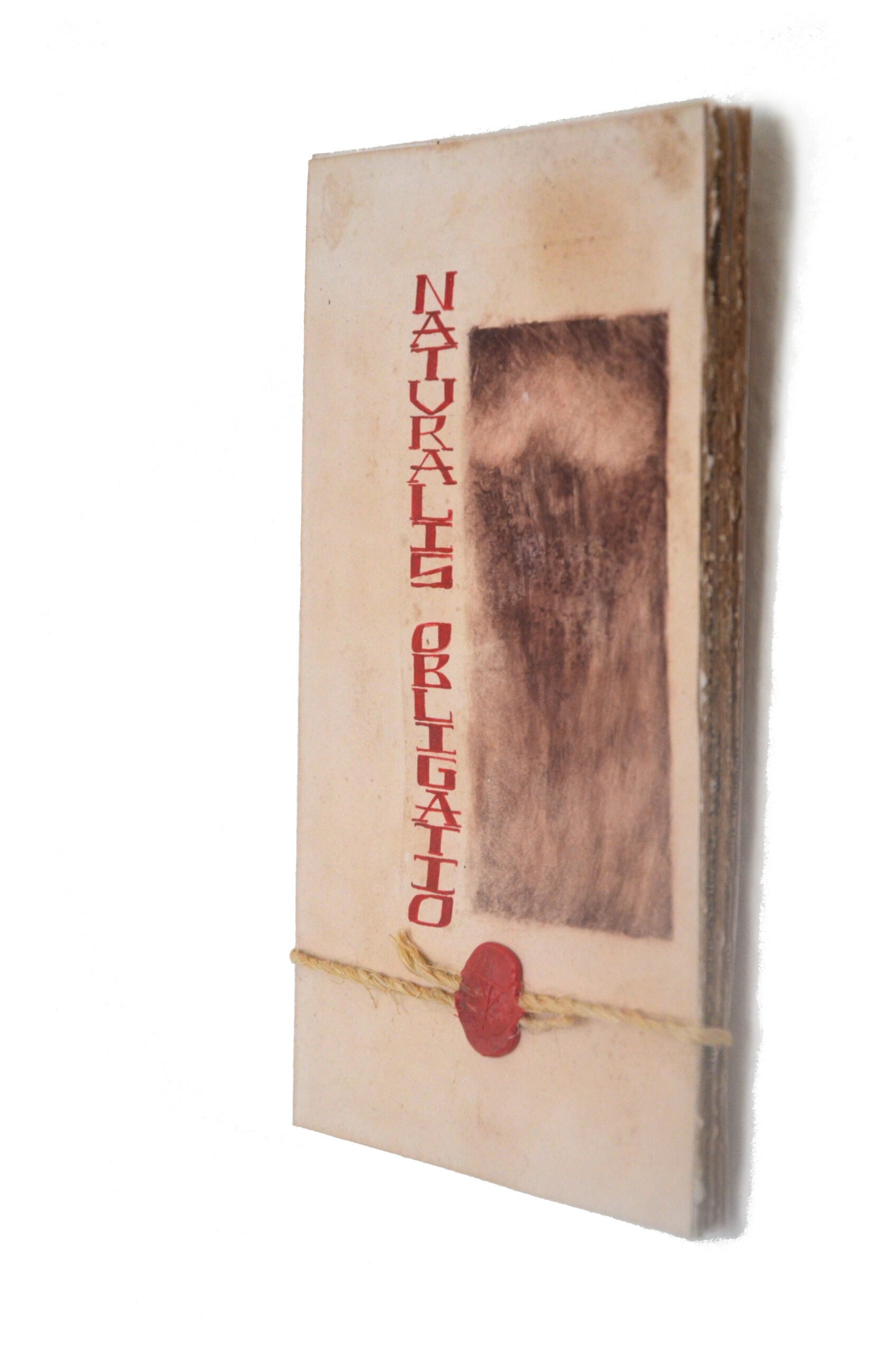
Incisione su plexiglas trasformata in monotipo su libro sigillato / Engraving on Plexiglas, monotype on a sealed book / Plexiglas-Radierung als Monotypie auf versiegeltem Buch
Ce travail est une étape transitionnelle entre la gravure sur plexiglas et le monotype. Ce qui a été gravé ne tient qu’à une frise gothique ainsi que de multiples rayures qui texturent la plaque. Le travail consiste ensuite surtout en un monotype, la frise gothique ajoutant une régularité et une structure à un paysage qui, sans cela, pousse l’impressionnisme dans le flou jusqu’à l’esquisse voire l’abstraction. Il est en effet question ici non pas d’un paysage particulier mais du paysage en tant que tel, en direction de questions ontologiques voire métaphysiques si l’on ose les gros mots. La terre présente une élévation centrale ainsi que deux autres, latérales. Cette partie sombre qui tient lieu de terre se poursuit vers le bas, mais s’achève ensuite dans une forme évasée. Ces formes évoquent une figure anthropomorphique, les pieds rapprochés, les bras élevés, dans une sorte de toge. La forme géométrique a quelque chose d’un immense collier. La terre est ainsi dotée d’un supplément d’âme, elle vit. Au-dessus d’elle, le ciel fait comme une auréole. Enfin, au sommet, le ciel est sombre, celui d’un crépuscule, ou d’une aurore, fermé en tous cas, pour rappeler l’immensité noire de ce qui se trouve au-delà.
Si l’on revient sur le « collier », la frise gothique centrale, elle montre l’existence d’une géométrie au cœur du paysage, en quelques sortes un ordre sacré, une architecture génétique qui sous-tend le monde observé sur le plan du phénomène.
Cet ordre central rendu visible pourrait générer le sublime. Ses témoins parlent de leur admiration pour ce que d’aucuns appellent une « géométrie sacrée ». Le propre du sublime est de ne pas s’en tenir à de l’admiration, et d’inspirer une crainte et du respect. Néanmoins le titre Naturalis obligatio désigne de son côté un devoir dépourvu de caractère exécutoire. Ainsi, semble-t-il, la nature, bien que possédant tous les critères pour imposer la crainte et l’admiration, semble ne pas toujours forcer les devoirs à son égard. Ses habitants ont-ils acquis suffisamment d’autonomie pour s’en défaire ? Question centrale du sublime, qui explore justement les rappels à l’ordre de la nature dans ses manifestations les plus violentes, autant occasions de remettre l’église au centre du village.
Quest’opera rappresenta una fase di transizione tra l’incisione su plexiglas e il monotipo. Ciò che è stato inciso consiste solo in un fregio gotico e in numerose strisce che conferiscono consistenza alla lastra. L’opera consiste poi soprattutto in un monotipo, con il fregio gotico che aggiunge regolarità e struttura a un paesaggio che, senza di esso, spinge l’impressionismo nella sfocatura fino allo schizzo o addirittura all’astrazione. Si tratta infatti qui non di un paesaggio particolare, ma del paesaggio in quanto tale, in direzione di questioni ontologiche o addirittura metafisiche, se si osano usare queste parole altisonanti. La terra presenta un’elevazione centrale e altre due laterali. Questa parte scura che funge da terra prosegue verso il basso, ma poi termina in una forma svasata. Queste forme evocano una figura antropomorfa, con i piedi ravvicinati, le braccia alzate, in una sorta di toga. La forma geometrica ha qualcosa di un immenso collare. La terra è così dotata di un’anima in più, è viva. Sopra di essa, il cielo fa da aureola. Infine, in cima, il cielo è scuro, quello di un crepuscolo o di un’aurora, chiuso in ogni caso, per richiamare l’immensità nera di ciò che si trova oltre.
Se torniamo alla «collana», il fregio gotico centrale, essa mostra l’esistenza di una geometria nel cuore del paesaggio, in un certo senso un ordine sacro, un’architettura genetica che sottende il mondo osservato sul piano del fenomeno.
Questo ordine centrale reso visibile potrebbe generare il sublime. I suoi testimoni parlano della loro ammirazione per quella che alcuni chiamano una «geometria sacra». La caratteristica del sublime è quella di non limitarsi all’ammirazione, ma di ispirare timore e rispetto. Tuttavia, il titolo Naturalis obligatio designa da parte sua un dovere privo di carattere esecutivo. Così, a quanto pare, la natura, pur possedendo tutti i criteri per imporre timore e ammirazione, sembra non imporre sempre doveri nei suoi confronti. I suoi abitanti hanno acquisito sufficiente autonomia per liberarsene? Domanda centrale del sublime, che esplora proprio i richiami all’ordine della natura nelle sue manifestazioni più violente, occasioni per «riportare la chiesa al centro del villaggio», come recita il detto francese.
This work represents a transitional stage between engraving on Plexiglas and monotype. The engraved elements consist solely of a Gothic frieze and numerous striations that give the plate its texture. The work then consists primarily of a monotype, with the Gothic frieze adding regularity and structure to a landscape which, without it, pushes impressionism into blurriness, verging on a sketch or even abstraction. Indeed, what is at stake here is not a particular landscape but the landscape as such, moving towards ontological or even metaphysical questions, if one dares to use such big words. The earth features a central elevation as well as two others, on either side. This dark section, which serves as the earth, continues downwards but then ends in a flared shape. These forms evoke an anthropomorphic figure, feet close together, arms raised, clad in a sort of toga. The geometric shape has something of a vast necklace about it. The earth is thus endowed with an extra measure of soul; it lives. Above it, the sky forms a sort of halo. Finally, at the summit, the sky is dark—that of twilight, or dawn—closed in any case, to evoke the black immensity of what lies beyond.
Returning to the ‘necklace’, the central Gothic frieze, it reveals the existence of a geometry at the heart of the landscape, a kind of sacred order, a genetic architecture underpinning the world as observed on the level of phenomena.
This central order, made visible, could generate the sublime. Its witnesses speak of their admiration for what some call ‘sacred geometry’. The very nature of the sublime is not to stop at admiration, but to inspire awe and respect. Nevertheless, the title Naturalis obligatio refers, for its part, to a duty that is not enforceable. Thus, it would seem that nature, although possessing all the criteria to command awe and admiration, does not always compel duties towards it. Have its inhabitants acquired sufficient autonomy to free themselves from it? This is the central question of the sublime, which explores precisely nature’s calls to order in its most violent manifestations—occasions, as it were, ‘to put the church back at the centre of the village’, as the French expression goes.
Diese Arbeit stellt eine Übergangsphase zwischen der Plexiglas-Radierung und der Monotypie dar. Das Radierte beschränkt sich auf einen gotischen Fries sowie zahlreiche Streifen, die der Platte Struktur verleihen. Die Arbeit besteht dann vor allem aus einem Monotypie, wobei der gotische Fries einer Landschaft Regelmäßigkeit und Struktur verleiht, die andernfalls den Impressionismus in die Unschärfe bis hin zur Skizze oder gar Abstraktion treibt. Es geht hier nämlich nicht um eine bestimmte Landschaft, sondern um die Landschaft an sich, hin zu ontologischen oder gar metaphysischen Fragen, wenn man es wagt, diese großen Worte zu verwenden. Die Erde weist eine zentrale Erhebung sowie zwei weitere seitliche Erhebungen auf. Dieser dunkle Teil, der als Erde fungiert, setzt sich nach unten fort, endet dann aber in einer sich ausbreitenden Form. Diese Formen erinnern an eine anthropomorphe Gestalt, die Füße eng beieinander, die Arme erhoben, in einer Art Toga. Die geometrische Form hat etwas von einer riesigen Halskette. Die Erde erhält so eine zusätzliche Seele, sie lebt. Über ihr bildet der Himmel eine Art Heiligenschein. Ganz oben schließlich ist der Himmel dunkel, wie in der Dämmerung oder im Morgengrauen, auf jeden Fall verschlossen, um an die schwarze Unendlichkeit dessen zu erinnern, was jenseits davon liegt.
Kehrt man zu der „Halskette“ zurück, dem zentralen gotischen Fries, so zeigt dieser die Existenz einer Geometrie im Herzen der Landschaft, gewissermaßen eine heilige Ordnung, eine genetische Architektur, die der auf der Ebene des Phänomens beobachteten Welt zugrunde liegt. Diese sichtbar gemachte zentrale Ordnung könnte das Erhabene hervorbringen. Ihre Zeugen sprechen von ihrer Bewunderung für das, was manche als „heilige Geometrie“ bezeichnen. Das Besondere am Erhabenen ist, dass es sich nicht auf Bewunderung beschränkt, sondern Ehrfurcht und Respekt einflößt. Dennoch bezeichnet der Titel Naturalis obligatio seinerseits eine Pflicht ohne zwingenden Charakter. So scheint es, als würde die Natur, obwohl sie alle Kriterien besitzt, um Ehrfurcht und Bewunderung zu erzwingen, nicht immer Pflichten ihr gegenüber auferlegen. Haben ihre Bewohner genügend Autonomie erlangt, um sich davon zu befreien? Eine zentrale Frage des Erhabenen, das gerade die Mahnungen der Natur in ihren heftigsten Erscheinungsformen untersucht – Gelegenheiten, „die Kirche wieder in den Mittelpunkt des Dorfes zu rücken“, wie es in der französischen Redewendung heißt.
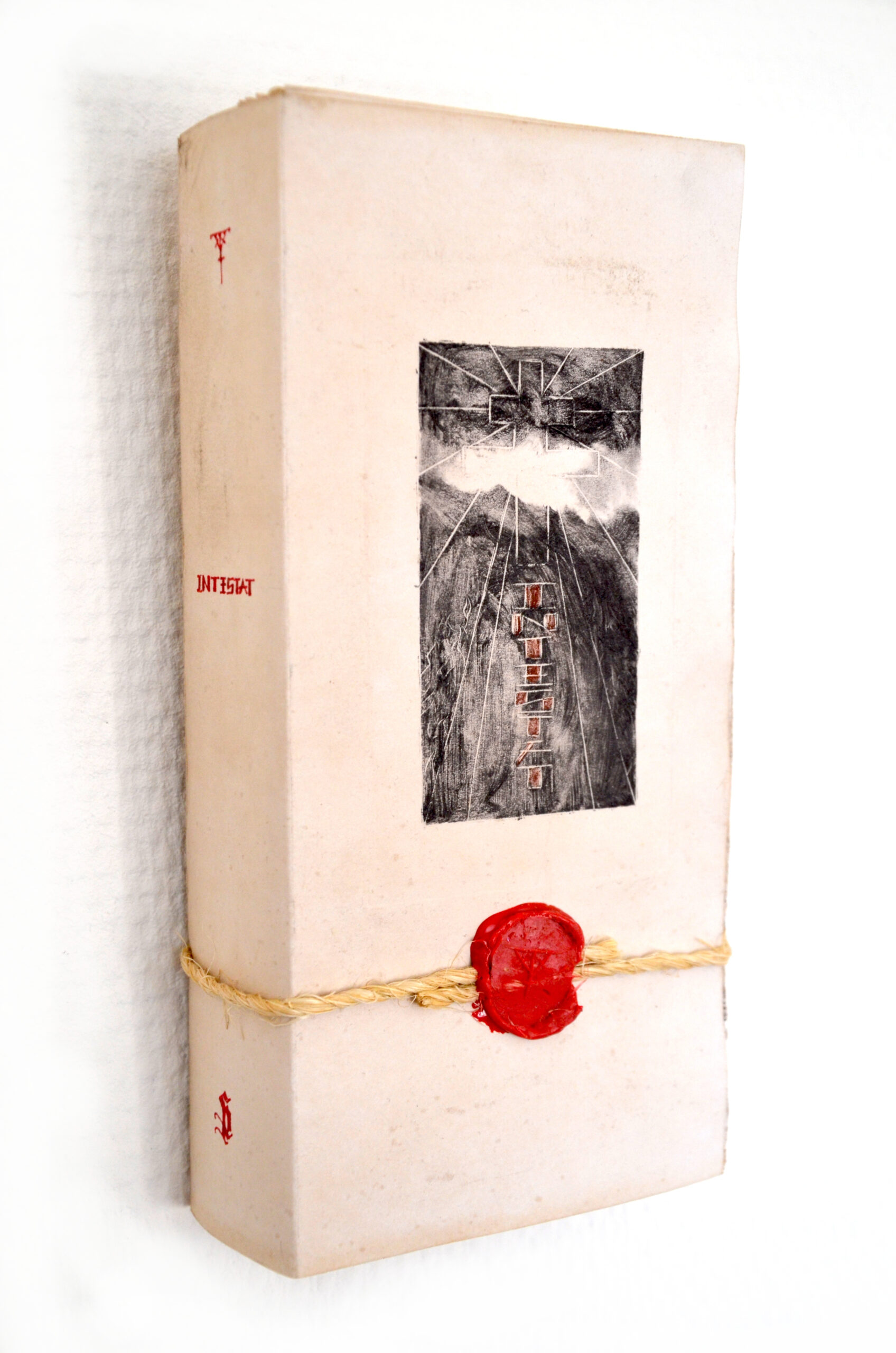
Incisione su zinco, monotipo su libro sigillato / zinc etching, a monotype on a sealed book / Zinkradierung als Monotypie auf versiegeltem Buch
Intestat : « sans testament ». Le monotype représente un paysage montagnard, et plus précisément l’étage élevé d’une vallée profonde, qui aurait pu, à une époque, être propice à la dissimulation des maquisards. La référence est directe, avec la croix de Lorraine qui domine l’image en fond. Or, cette croix est visible en creux. Au sens propre : le support en zinc qui a servi au monotype a été gravé, figurant ainsi entre autres la croix de Lorraine. Or les sillons de cette gravure sont précisément le seul endroit qui n’a pas retenu l’encre, si ce n’est le ciel à la lumière vive. Ainsi le monde décrit par le monotype inclut littéralement tout sauf la croix de Lorraine, une absence que rappelle le titre Intestat. La croix de Lorraine est absente autant dans le paysage représenté que dans les testaments. Aujourd’hui absentes ou ignorées (elle est en fait absente de façon tellement évidente qu’elle « brille par son absence »), la croix de Lorraine, ou la Résistance, sont pourtant la pierre angulaire de notre histoire contemporaine et de notre système politique français actuel. C’est ainsi une question posée au regardeur : que reste-t-il de la mémoire de la Résistance aujourd’hui ? Est-elle en train de disparaître avec ses derniers témoins vivants ? Cela veut-il dire que la mémoire demeurant dans les livres n’est que lettre morte ?
Intestat: «senza testamento». Il monotipo raffigura un paesaggio montano, e più precisamente l’altopiano di una valle profonda, che un tempo avrebbe potuto essere un luogo propizio per nascondere i partigiani. Il riferimento è diretto, con la croce di Lorena che domina l’immagine sullo sfondo. Tuttavia, questa croce è visibile in rilievo. In senso letterale: il supporto in zinco utilizzato per il monotipo è stato inciso, raffigurando così, tra le altre cose, la croce di Lorena. Ma i solchi di questa incisione sono proprio l’unico punto che non ha trattenuto l’inchiostro, se non il cielo illuminato da una luce intensa. Così il mondo descritto dal monotipo include letteralmente tutto tranne la croce di Lorena, un’assenza che richiama il titolo Intestat. La croce di Lorena è assente tanto nel paesaggio rappresentato quanto nei testamenti. Oggi assente o ignorata (è infatti assente in modo così evidente da «brillare per la sua assenza»), la croce di Lorena, o la Resistenza, sono tuttavia la pietra angolare della nostra storia contemporanea e del nostro attuale sistema politico francese. Si tratta quindi di una domanda posta allo spettatore: cosa resta oggi della memoria della Resistenza? Sta scomparendo insieme ai suoi ultimi testimoni viventi? Questo significa che la memoria che rimane nei libri è solo lettera morta?
Intestat: ‘without a will’. The monotype depicts a mountainous landscape, and more specifically the upper reaches of a deep valley, which might once have been a suitable hiding place for members of the Resistance. The reference is direct, with the Cross of Lorraine dominating the background of the image. However, this cross is visible in relief. Literally speaking: the zinc plate used for the monotype was engraved, depicting, among other things, the Cross of Lorraine. Yet the grooves of this engraving are precisely the only place that did not retain the ink, save for the brightly lit sky. Thus the world depicted by the monotype literally includes everything except the Cross of Lorraine, an absence echoed by the title Intestat. The Cross of Lorraine is absent both from the landscape depicted and from the wills. Now absent or ignored (it is in fact so conspicuously absent that it ‘is conspicuous by its absence’), the Cross of Lorraine, or the Resistance, is nevertheless the cornerstone of our contemporary history and of our current French political system. This thus poses a question to the viewer: what remains of the memory of the Resistance today? Is it disappearing along with its last living witnesses? Does this mean that the memory preserved in books is nothing but a dead letter?
Intestat: „ohne Testament“. Der Monotyp zeigt eine Berglandschaft, genauer gesagt den oberen Teil eines tiefen Tals, der einst ein idealer Unterschlupf für die Widerstandskämpfer gewesen sein könnte. Der Bezug ist direkt, mit dem Lothringer Kreuz, das das Bild im Hintergrund dominiert. Dieses Kreuz ist jedoch als Vertiefung sichtbar. Im wörtlichen Sinne: Der Zinkträger, der für den Monotypie-Druck verwendet wurde, wurde graviert und zeigt unter anderem das Lothringer Kreuz. Doch die Rillen dieser Gravur sind genau die einzige Stelle, an der keine Farbe haften geblieben ist, abgesehen vom hell erleuchteten Himmel. So umfasst die durch den Monotypie-Druck beschriebene Welt buchstäblich alles außer dem Lothringer Kreuz – eine Abwesenheit, an die der Titel „Intestat“ erinnert. Das Lothringer Kreuz fehlt sowohl in der dargestellten Landschaft als auch in den Testamenten. Heute abwesend oder ignoriert (es fehlt tatsächlich so offensichtlich, dass es „durch seine Abwesenheit glänzt“), sind das Lothringer Kreuz oder die Résistance dennoch der Eckpfeiler unserer Zeitgeschichte und unseres heutigen französischen politischen Systems. So wird dem Betrachter eine Frage gestellt: Was bleibt heute von der Erinnerung an die Résistance? Verschwindet sie mit ihren letzten noch lebenden Zeitzeugen? Bedeutet das, dass die in Büchern verbleibende Erinnerung nur leere Worte sind?
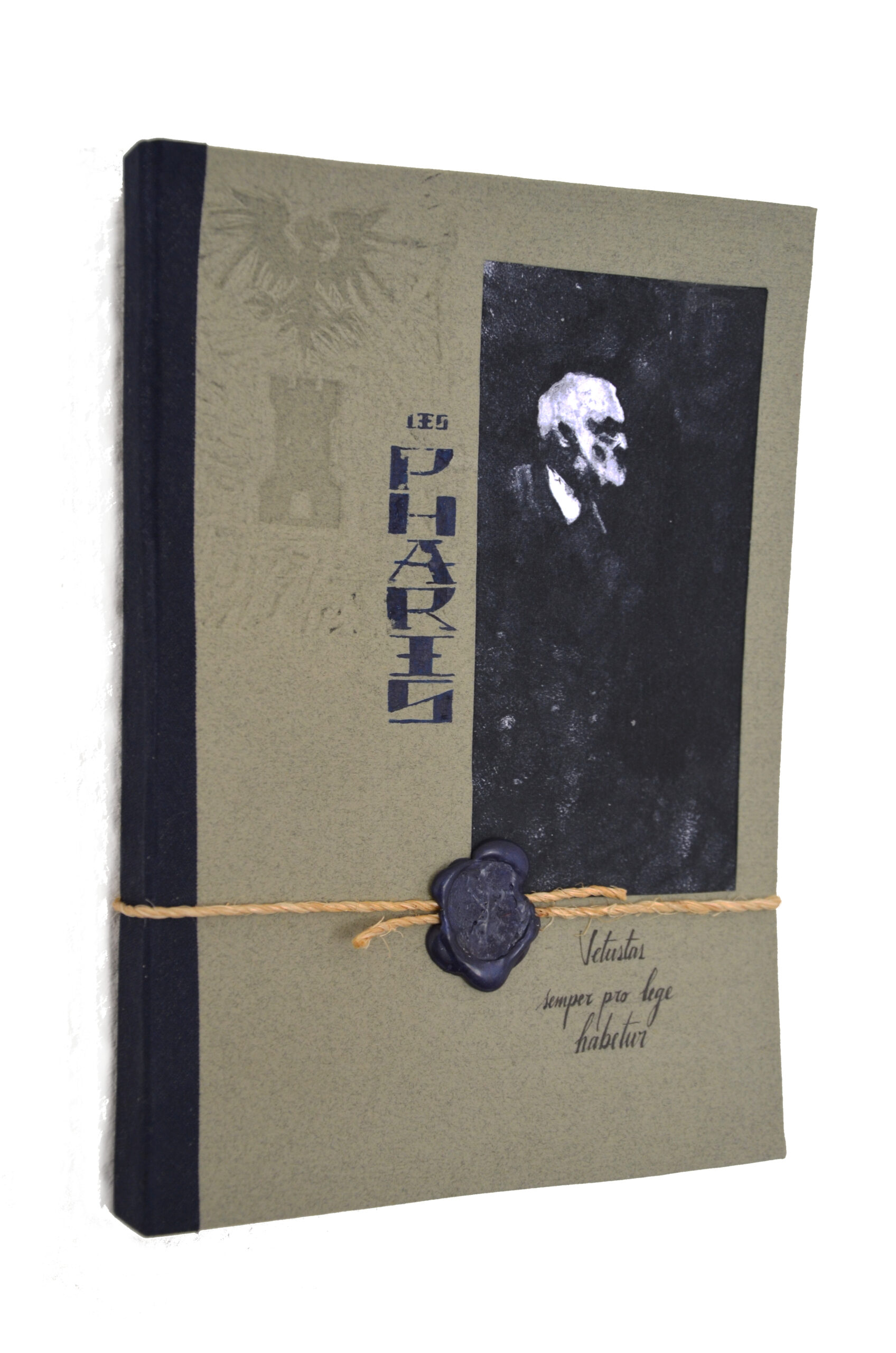
Monotipo su libro sigillato / Monotype on a sealed book / Monotypie auf versiegeltem Buch
Vetustas semper pro lege habetur : « L’ancienneté est toujours tenue pour loi ». Ce sous-titre nous encourage à une lecture baudelairienne du titre, Les Phares, référence au poème du même nom identifiant une sélection de guides esthétiques au poète. Victor Hugo, représenté de profil sur cette couverture, semble en être une incarnation. Auteur extrêmement populaire, de son vivant de même que dans la postérité, mais également guidé par un sens du clair-obscur et du sublime qui guide le présent travail, il constitue une allégorie toute trouvée, à la fois universelle et personnelle, des « phares » qui nous guident.
Trois colonnes verticales, rappelant la forme des phares du littoral, structurent la couverture. Trois points d’appui, allant du faible contraste de l’embossage de gauche au bloc noir de droite, offrent une solidité monumentale à l’ensemble. L’embossage représente les armes de Maurienne. La tour rappelle explicitement les phares, tandis que l’aigle (royal ?) incarne le prestige. Gérard de Nerval en parlait ainsi : « C’est que l’aigle seul […] contemple impunément le soleil et la gloire. » Le titre de l’ouvrage est vertical, et l’on pourra apprécier l’ambivalence de la lettre « E » majuscule notamment, qui regarde à la fois à gauche et à droite, comme les phares regardent à 360 degrés. Le portrait de Victor Hugo enfin rappelle la lumière isolée d’un phare dans la nuit, mais peut-être également son œuvre : d’une densité profonde comme le noir de cette image, et illuminée par quelque acte sublime. « Un éclair dans la nuit » pourrait seoir à l’œuvre hugolienne.
Que renferme ce livre ? Des phares. Pourquoi ce sceau ? Car il nous semble que l’admiration et l’exemplarité sont des qualités moins en vogue, ignorées. Pourtant, dans un monde désorienté ou simplement guidé par la résistance à l’abject, il semble urgent de sortir de son égarement et de retrouver nos phares qui éclairent encore, mais seuls dans la nuit.
Vetustas semper pro lege habetur: «L’antichità è sempre considerata legge». Questo sottotitolo ci invita a una lettura baudelairiana del titolo, Les Phares, che rimanda all’omonima poesia in cui il poeta individua una serie di modelli estetici. Victor Hugo, raffigurato di profilo su questa copertina, sembra esserne un’incarnazione. Autore estremamente popolare, sia in vita che nella posterità, ma anche guidato da un senso del chiaroscuro e del sublime che ispira il presente lavoro, egli costituisce un’allegoria perfetta, al tempo stesso universale e personale, dei «fari» che ci guidano.
Tre colonne verticali, che richiamano la forma dei fari della costa, strutturano la copertina. Tre punti di appoggio, che vanno dal debole contrasto della goffratura a sinistra al blocco nero a destra, conferiscono una solidità monumentale all’insieme. La goffratura rappresenta lo stemma della Maurienne. La torre richiama esplicitamente i fari, mentre l’aquila (reale?) incarna il prestigio. Gérard de Nerval ne parlava così: «È che solo l’aquila […] contempla impunemente il sole e la gloria». Il titolo dell’opera è verticale, e si potrà apprezzare l’ambivalenza della lettera «E» maiuscola in particolare, che guarda sia a sinistra che a destra, come i fari guardano a 360 gradi. Il ritratto di Victor Hugo, infine, ricorda la luce solitaria di un faro nella notte, ma forse anche la sua opera: di una densità profonda come il nero di questa immagine, e illuminata da qualche atto sublime. «Un lampo nella notte» potrebbe ben descrivere l’opera hugoliana.
Cosa racchiude questo libro? Dei fari. Perché questo sigillo? Perché ci sembra che l’ammirazione e l’esemplarità siano qualità meno in voga, ignorate. Eppure, in un mondo disorientato o semplicemente guidato dalla resistenza all’abietto, sembra urgente uscire dal proprio smarrimento e ritrovare i nostri fari che illuminano ancora, ma soli nella notte.
Vetustas semper pro lege habetur: ‘Antiquity is always regarded as law’. This subtitle encourages us to interpret the title, Les Phares, in a Baudelairean manner, referring to the poem of the same name which identifies a selection of aesthetic guides for the poet. Victor Hugo, depicted in profile on this cover, seems to be an embodiment of this. An immensely popular author, both in his lifetime and in posterity, yet also guided by a sense of chiaroscuro and the sublime that informs this work, he constitutes a perfect allegory—both universal and personal—of the ‘lighthouses’ that guide us.
Three vertical columns, reminiscent of the shape of coastal lighthouses, structure the cover. Three points of support, ranging from the subtle contrast of the embossing on the left to the black block on the right, lend the whole a monumental solidity. The embossing depicts the coat of arms of Maurienne. The tower explicitly evokes lighthouses, whilst the eagle (a golden eagle?) embodies prestige. Gérard de Nerval put it this way: “For it is the eagle alone […] that gazes with impunity upon the sun and glory.” The title of the work is vertical, and one can appreciate the ambivalence of the capital ‘E’ in particular, which looks both left and right, just as lighthouses scan 360 degrees. Finally, the portrait of Victor Hugo evokes the solitary light of a lighthouse in the night, but perhaps also his work: of a depth as profound as the blackness of this image, and illuminated by some sublime act. “A flash of lightning in the night” might well describe Hugo’s work.
What does this book contain? Lighthouses. Why this theme? Because it seems to us that admiration and exemplarity are qualities that are less in vogue, ignored. Yet, in a world that is disoriented or simply guided by resistance to the abject, it seems urgent to emerge from our confusion and rediscover our lighthouses, which still shine, but alone in the night.
Vetustas semper pro lege habetur: „Das Alte gilt stets als Gesetz“. Dieser Untertitel regt uns zu einer baudelairischen Lesart des Titels Les Phares an, einem Verweis auf das gleichnamige Gedicht, das eine Auswahl ästhetischer Leitbilder des Dichters aufzeigt. Victor Hugo, der auf diesem Einband im Profil abgebildet ist, scheint eine Verkörperung davon zu sein. Als äußerst beliebter Autor, sowohl zu Lebzeiten als auch in der Nachwelt, der zudem von einem Sinn für Hell-Dunkel und das Erhabene geleitet wurde, der auch das vorliegende Werk prägt, stellt er eine naheliegende Allegorie dar, die zugleich universell und persönlich ist, für die „Leuchttürme“, die uns leiten.
Drei vertikale Säulen, die an die Form der Leuchttürme an der Küste erinnern, strukturieren das Cover. Drei Stützpunkte, die vom schwachen Kontrast der Prägung auf der linken Seite bis zum schwarzen Block auf der rechten Seite reichen, verleihen dem Ganzen eine monumentale Solidität. Die Prägung stellt das Wappen der Maurienne dar. Der Turm erinnert explizit an Leuchttürme, während der (königliche?) Adler das Prestige verkörpert. Gérard de Nerval drückte es so aus: „Denn nur der Adler […] blickt ungestraft auf die Sonne und den Ruhm.“ Der Titel des Werks ist vertikal angeordnet, und man kann insbesondere die Ambivalenz des Großbuchstabens „E“ erkennen, der zugleich nach links und nach rechts blickt, so wie die Leuchttürme einen Rundumblick von 360 Grad bieten. Das Porträt von Victor Hugo schließlich erinnert an das einsame Licht eines Leuchtturms in der Nacht, vielleicht aber auch an sein Werk: von einer Tiefe, so tief wie das Schwarz dieses Bildes, und erhellt von einer erhabenen Tat. „Ein Blitz in der Nacht“ könnte zu Hugos Werk passen. Was verbirgt dieses Buch? Leuchttürme. Warum dieses Motto? Weil es uns so erscheint, als seien Bewunderung und Vorbildlichkeit Eigenschaften, die weniger im Trend liegen und ignoriert werden. Doch in einer desorientierten Welt oder einer Welt, die sich lediglich durch den Widerstand gegen das Abscheuliche leiten lässt, scheint es dringend notwendig, aus der Verirrung herauszufinden und unsere Leuchttürme wiederzuentdecken, die noch immer leuchten, wenn auch allein in der Nacht.